
Season 2 of the Advertising Economic Forum Podcast on Quo Vadis is here. We kicked things off with none other than Ari Paparo. In Episode 1, we dove into a rarely discussed area of Ari’s recent book, “Yield”, and uncovered an insight that goes beyond the surface of adtech and media economics. As you'd expect with Ari, we had a candid conversation that sets the tone for the season ahead with the industry’s most original thinkers.
Episode 2 features a thought-provoking conversation with the legendary Rishad Tobaccowala. We explored what management and leadership look like in the age of massive creative destruction, and Rishad—true to form—delivered his trademark insights and zingers like the sharp distinction between culture and cult, reminding us that “culture is neither a place nor a spa,” but something far more essential to leadership and organizational health. Tune in to the new episodes on Spotify or Apple.
Transaction ID

TID stands for Transaction ID, a unique identifier used to link bid requests to the same impression auction. Traditionally, in Prebid.js and OpenRTB protocols, this identifier was uniform across all bidders in a given auction, enabling DSPs to recognize thouands of duplicate requests and bid more efficiently. That sounds like something buyers and sellers in a rational market would want to do.
Not so fast. Before a few weeks ago, publishers could opt in to TID. Some did, some did not. In fact, The Trade Desk reported that 59% of bid requests were coming with a TID. Then prebid.org decided to tweak TID on behalf of publishers making it pretty much useless.
Game Setup
A heated discussion over TID ignited a few weeks ago when adtech industry veteran Mike O’Sullivan asked a simple but powerful question on LinkedIn:
“What are the principled reasons for not supporting Transaction ID? Ian Meyers and I were struggling to identify these, so I'd love to hear some alternative points of view.”
The idea is simple: Every ad auction on a publisher's page (prebid stack) gets a unique ID. That ID is included in bid requests sent to DSPs to signal, “Hey, these bids are all part of the same auction.” This common-sense signal (that’s what Mike does) help DSPs avoid bidding multiple times on the same opportunity, match metadata, and boost transparency.
Why it matters: With transaction IDs, DSPs can detect that multiple bid requests refer to a single on-page auction. That helps prevent redundant bids and identify manipulative behaviors. More importantly, TID enhances the integrity of open web programmatic ad buying in an environment where the biggest competitive threat is not adtech players engaging in a knife fight amongst themselves. The big competitor is watching more media money flow away from the open web to walled gardens, where the perception of results creates superior optics with fewer headaches. While open web players continue to fight it out, the walled gardens sit back and let them.
Publisher Response: Many publishers reacted defensively to the change. They claim exposing the final auction identity leads to data leakage and reduces their ability to obscure (or misrepresent) bid requests, which in turn cuts into an already tough revenue environment. In the publisher’s defence, Paul Bannister said it best as usual:
“With a transaction ID, any intermediary that has bidstream access (DSP, curator, exchange, etc.) can steal my data.”
The Player Situation
Publishers need more revenue now, so they prefer to withhold TID. Meanwhile, advertisers continue to move dollars away from open web inventory, which is bad for everyone involved, including DSPs.
Advertisers are moving money out of the open web for a variety of good reasons, and none of them have anything to do with ad quality or transparency issues. Advertisers don’t really care about transparency, which is easily observed by how much media they allocate to walled gardens. Instead, what they care about is allocating money toward audiences that can be targeted with the most efficacy (e.g., efficient and effective at the same time) and generate the best results/optics which can be real or perceived.
Two Advertiser Types: Brand advertisers want to spend media dollars on target-accurate audiences with a loss aversion mindset, e.g., not losing what they already think they have (brand equity). Direct response advertisers are a different species; they spend media dollars on target-accurate audiences to get the most incremental lift on sales. Either way, both types of advertisers want target-accurate audiences. This is where walled gardens have an increasing comparative advantage.
Buying agents like DSP that represent advertisers want more efficient bidding to reduce the high cost of number crunching and deliver walled garden-like performance to their customers.
The environment: Supposedly, everyone hopefully wants to minimize power usage and minimize CO2 emissions from all the excess number crunching, which creates a negative externality. Society ends up paying the extra cost for the open web’s inefficient buy-sell process created by SSPs and DSPs that have a strong incentive to produce and buy low-quality and unidentifiable “viewable” tonnage.
Nasty Nash Equilibrium
Here’s the game layout in a two player setup: DSP and Publisher.
The Publisher can decide to send TID to DSPs (or not). If the DSP values this extra information, the DSP can decide to pay more (or not).
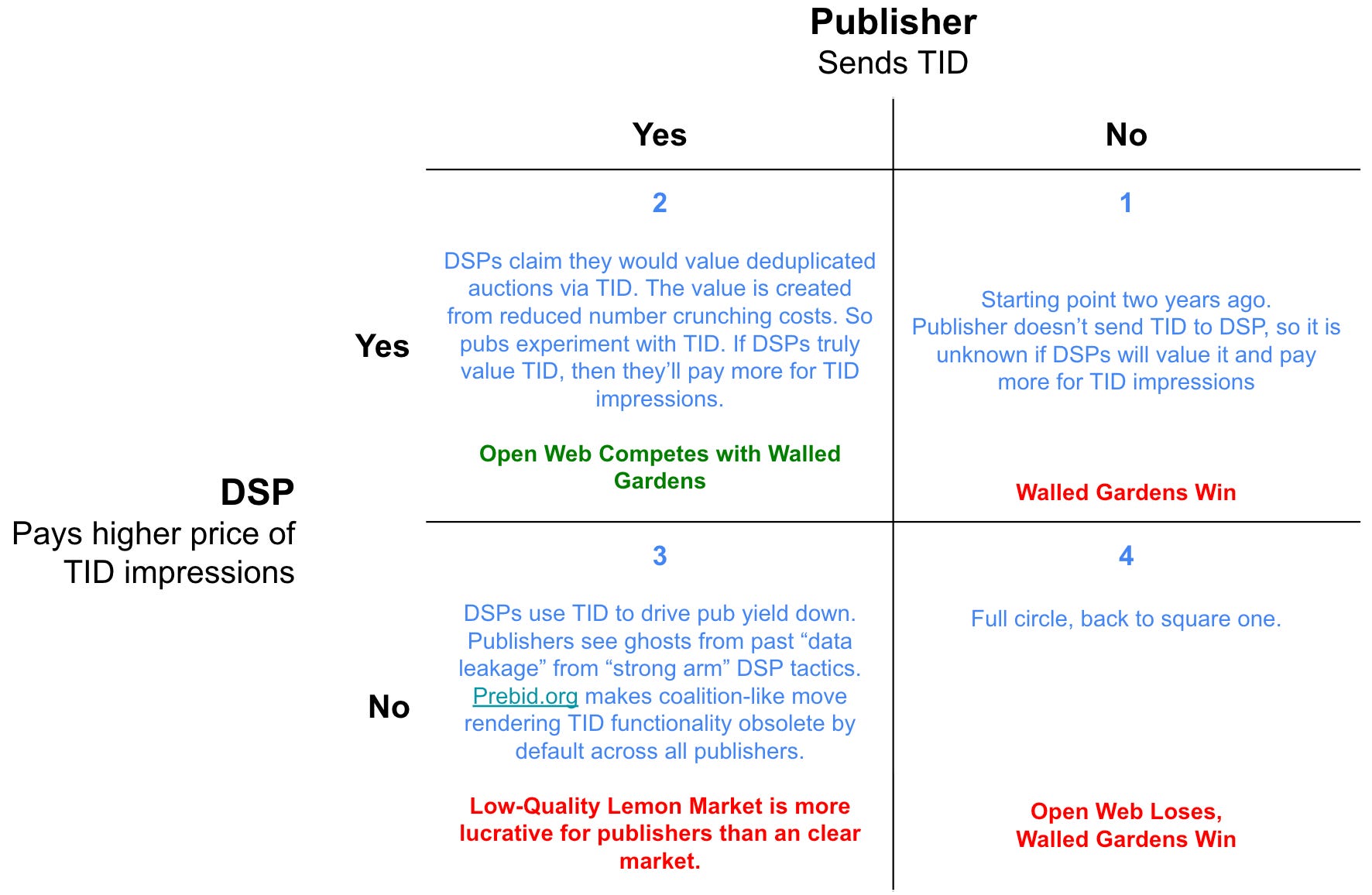
Let’s start with Box 1. In the beginning, the publisher can’t send TID to the DSP because it does not exist. At that point, it is unknown whether or not the DSP will value the extra information and bid up for “clean-path” impressions with TID. The walled gardens are winning and continue to win without having to carry around the burden of an overly complex supply chain that very few people understand.
Moving on to Box 2, publishers experiment with TID. The proof is in the pudding: If DSPs value it, they will bid higher and get better impressions for their advertisers, resulting in better performance. All the players should be happy. If this scenario continues to play out, the open web can better compete with the walled garden’s gravitational mass which increasingly attracts more media money.
The reality of Box 3 sets in. Instead of valuing TIDs and sharing the value with publishers in the form of higher CPM yields, DSPs use the information to bid lower. It turns out that the incentive to push low-quality tonnage with poor or confusing information is better for publishers, so prebid.org made TIDs useless.
Full circle back to Box 4. At this point, the open web ends up back where it started. No TIDs with ridiculous levels of bid duplication followed by waning interest and market share for the open web.
Game Result: Walled gardens win. DSPs lose. Publishers lose. SSPs lose. The open web loses.
The Frog and the Scorpion
The parable of the frog and the scorpion is a classic fable about human (or business) nature.
In the story, a scorpion asks a frog to carry him across a river. The frog hesitates, saying, “But if I let you on my back, you’ll sting me, and I’ll die.”
The scorpion replies, “That wouldn’t make sense—if I sting you, we’ll both drown. So you can trust me.”
Convinced by the logic, the frog agrees and starts swimming with the scorpion on his back. But halfway across, the scorpion stings the frog anyway. As they both begin to sink, the frog cries out, “Why did you do that? Now we’ll both die!”
The scorpion simply replies: “I couldn’t help it. It’s in my nature.”
From what we can observe, the TID debacle fits the parable. In this version, the DSP is the scorpion and the publisher is the frog. The DSP works on behalf of advertisers looking to buy the best ad inventory possible at the lowest price to get the most return.
The DSP needs to get across the river to access publisher audiences in the most efficient way possible. A straight is better than a risky zigzag path. As we can all observe with the TID debacle, the frog does the right thing thinking the scorpion will value TIDs appropriately, but it gets stung with devalued bidding action and data leakage is used against it. If this cycle of mistrust and self-protection continues, then they will both drown their own open web river as advertiser budgets will increasingly flow toward walled gardens. End of story.
A Path Forward
The solution is simple but not easy if the open web is going to stop replaying the same losing lemon market cycle: Real cooperation around shared standards that improve efficiency and integrity is the only way forward. Protecting positions instead of reaching mutual benefit is an an accelerant toward irrelevance in the advertiser’s mind and budget.
Publishers should not have to give transparency away for free. TIDs should be priced, valued, and turned into a competitive edge. And DSPs should not have to settle for poor bidding information. If they value better informatin they should pay for it.
If so, advertisers get what they truly want from the open web: Meaningful audiences reached more effectively and more efficiently.
The open web’s big challenge is to stop fighting each other in a stag hunt of mistrust and start coordinating to maintain a fair share of the media pie. If the industry can align incentives around surplus value creation, then the programmatic opeb web can still become not just an alternative to the walled gardens, but a credible, sustainable counterweight.
The open web still has a massive opportunity. It’s not going to be easy. It requires a single leader (not committees) to turn a plan into mutual benefit and a new reality that attracts advertising dollars.
Who that single leader is hard to say, so take some advice from David Ogilvy:
“In my experience, committees (IAB Tech Lab, Prebid.org, ANA, WFA, 4As, etc.) can criticize, but they cannot create. Search the parks in all your cities and you’ll find no statues of committees.”
Disclaimer: This post, and any other post from Quo Vadis, should not be considered investment advice. This content is for informational purposes only. You should not construe this information, or any other material from Quo Vadis, as investment, financial, or any other form of advice.
The flaw in this argument is that TID's effect is only pricing. An impression with a global TID isn't more valuable since it contains no additional information that enables better targeting or more efficient buying beyond price.. TID is a mechanism for price comparison among multiple supply paths, so it has to bring publisher prices down on average.
The argument then should be that publisher CPMs are too high on average and that hurts open web performance vs. walled gardens. Given the financial situation of most publishers, this is a tough argument to make since the biggest danger the open web faces is publishers becoming financially unviable.