
Advertising Economic Forum is coming back to NYC on March 18 and 19, 2026. It’s where the business of advertising meets economics and finance. The forum is the first and only event experience that brings together the thinkers and doers who define and redefine value creation across the $1 trillion global advertising ecosystem. Founders, venture, private equity, corporate development, M&A, equity analysts, CFOs, and CEOs.
Day 1 features our high-energy Founder + VC pitch competition hosted at Horizon Media. If you’re working on Agentic Agency, Agentic Creative, Buyer/Seller Agents, or Cognitive Commerce, and you’re bold enough to pitch your worldview thesis to a live audience on March 18, then get on our application list.
Day 2 is our “Davos of Advertising” experience, a closed-door, off-the-record forum where leaders reassess the probabilities of who’s winning and losing in the rapidly changing advertising market. If you’d like to attend, register your interest today!
From Matching to Clearing: Designing the Protocol Stack for Agentic AdTech
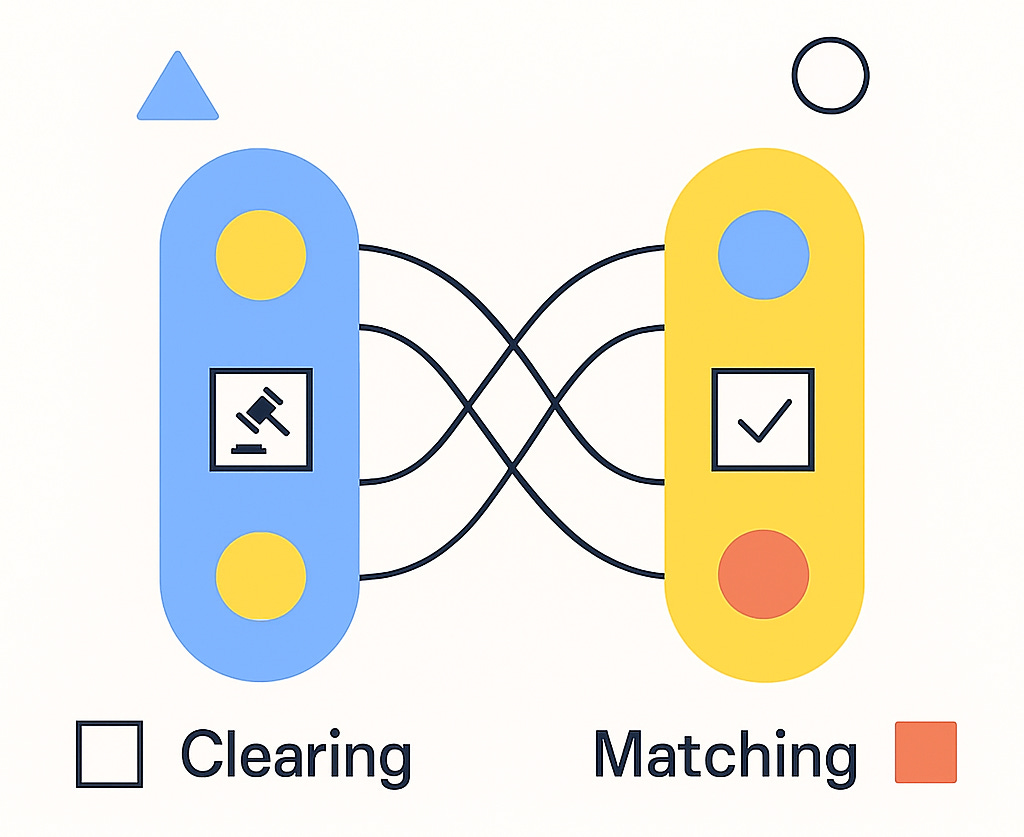
Last week in our post, A Matching Algorithm for an AdCP Stable Market, we laid out how the classic theory of Gale-Shapley stable matching offers a blueprint for a coordination layer in AdTech Context Protocol (AdCP). Similar to how dating apps match potential mates, we explored how seller-side agents (publishers) can propose, buy-side agents (advertisers) can accept or defer, and how such a proposal model can generate stable matching under conditions of well-specified preferences and capacity constraints.
When we examine the buyer-seller universe, we estimate there are ~13 trillion unique buyer-seller pairs possible. That’s precisely why some kind of matching system is necessary.
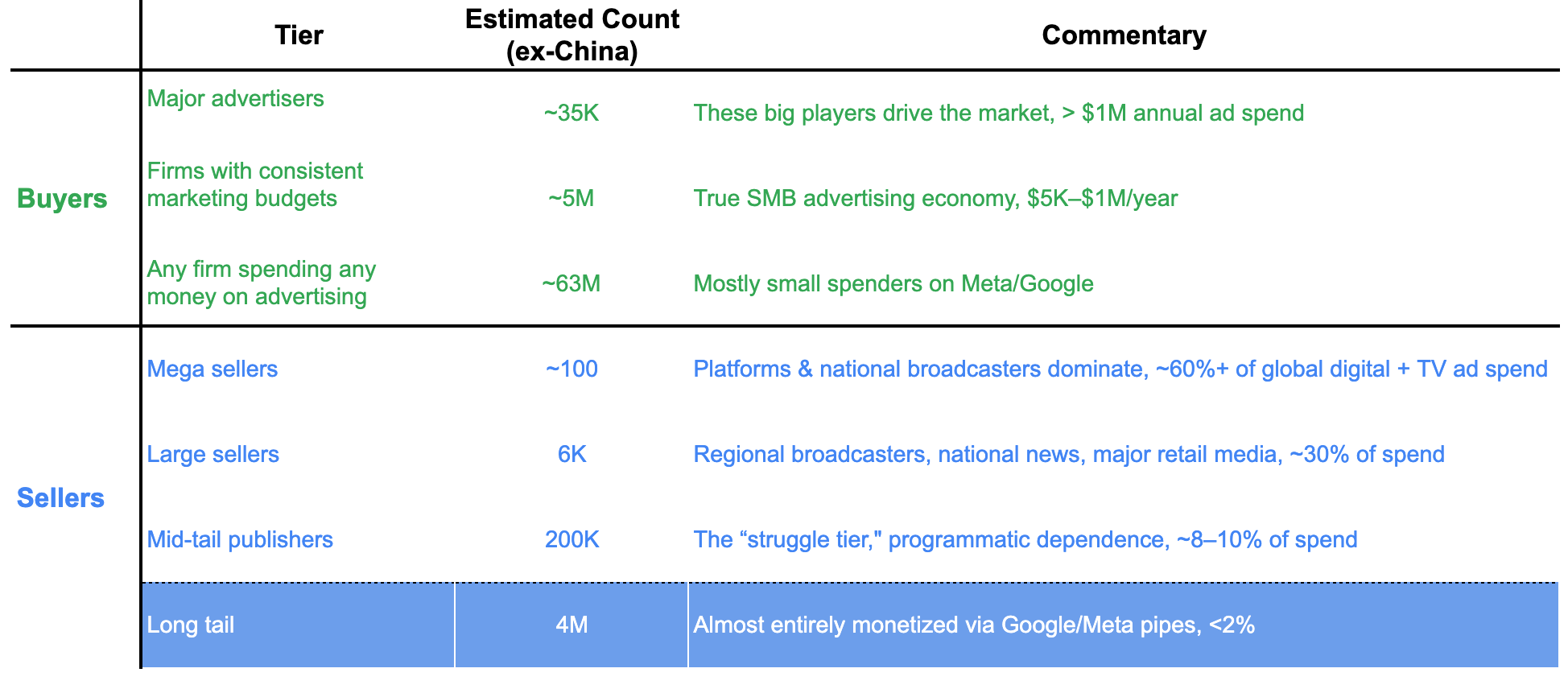
Assuming our estimates are close enough, if every advertiser operates through a buyer-side agent and every meaningful media seller (excluding the 4 million long-tail sites that monetize passively through pipes) operates through both buy-side and sell-side agents, the addressable matching and trading surface is massive. Imagine a human being’s brain trying to find optimality and stability with so many options. Not gonna happen.
If we include the millions of long-tail sites and imagine how they get tranched into curated deal IDs like ETFs that get sliced and diced into tons of potential baskets, then the number of unique pairs gets way bigger.
When each buyer agent can, in principle, evaluate and match against every seller agent, the marketplace does not resemble today’s auction environment at all. Instead, it becomes a dense, multi-bidirectional matching graph with trillions of potential buyer–seller pairs.
If we restrict the model to the true apex of the market, roughly ~1,500 to 3,000 global mega-advertisers who spend tens to hundreds of millions per year, and the ~50–150 mega-scale media sellers who control the majority of consumer attention, the agentic marketplace becomes much more compact.
At that level, the total trading surface consists of approximately ~200,000 unique buyer–seller match pairs. This is the layer where strategy, negotiation, and long-term relationships actually matter (think Cannes Lions). The challenge here is not so much about supply discovery. It’s more about clearing and coordinating persistent counterparties efficiently and in a manner where middle players can make their take.
The Gale-Shapley matching framework proposed in our last post seems ideal when the “deal” looks like the old world of direct guaranteed media buying for a specific impression, at a specific CPM, within a specific timeframe. In that sense, agentic systems are simply automating what human media salespeople and media buyers do today. That alone is a compelling innovation, particularly for high-value CTV inventory/audiences, but it’s not the full picture of what advertisers actually value.
Two layers, one market fabric
Whether we look at trillions or a few hundred thousand unique matches and how these relationships actually operate, we see that the “match” itself is only the starting point. What advertisers observedly prefer is real-time audience targeting. That preference in the brave new agentic world introduces a second layer of complexity:
Once buyer and seller agents are matched, how does the trade clear in real time? And at what price, under what rules, and with what learning feedback?
That’s where market-design (stable matching) ends, and mechanism design begins. Mechanism design is the study of how protocols, auctions, and incentives govern value exchange. In other words, matching establishes who can trade. Mechanism design defines how they transact. Together, they form an architecture of where we think AdCP could go to make programmatic advertising what it always wanted to be (e.g., not a lemon market).
Let’s consider a system as two broad layers:
Layer 1 is Matching (Market Design). This layer is about who trades with whom. It defines a network of counter-parties. Think of it in terms of Metcalfe’s Law, which states that the value of a network grows with the square of its number of connected participants (aka, “nodes,” where value = n²). In other words, each new participant adds value not linearly but exponentially, because they can potentially connect with all others.
Let’s imagine AdCP as the “network operating system” for agentic advertising markets. On one hand, Metcalfe’s Law describes the network externality where the more buyer and seller agents join the protocol, the more valuable it becomes to every participant. On the other hand, market design ensures stability and incentive alignment within that growing network such that new connections don’t just create noise or spam (the current “lemon market”) but instead produce stable matches and efficient clearing.
Without sound market design, the growth predicted by Metcalfe’s Law very likely ends up collapsing under its own weight because more participants simply means more friction, more instability, and more arbitrage (sound familiar?). With a viable market design, the exponential potential of network effects can generate enduring value (e.g., a market of peaches instead of lemons).
Layer 2 is Clearing (Mechanism Design): Given a matched pair (or set of eligible pairs), how do they negotiate or bid to determine price, volume, and execution terms in milliseconds?
If the smart people out there in AdTech Land only design matching and ignore clearing, then we end up with static pairs that don’t transact optimally. If we only run real-time bidding and ignore the matching universe, then we end up with the current auction chaos (which only a small handful of people truly understand), a non-persistent structure, high friction, and wasted media dollars.
Why both layers matter
Before matching and clearing can work together, the market needs to 1) remember who it’s dealing with, 2) compete to discover real value, and 3) execute all of it in milliseconds.
Trust and efficiency require persistence: Matching embeds a memory of past outcomes, preference rankings, and confidence scores. Efficient matching between potential mates turns one-time auctions into relationship-based trading. That’s critically important when you put it into the perspective of trust levels introduced by psychologists Roy Lewicki and Benton Bunker. In their work at Stanford and Berkeley in the 90s, they refer to three levels of trust:
Deterrence-based: This is the most basic level, based on the idea that people (agents) will behave trustworthily because the costs of breaking trust outweigh the benefits as a rational calculation of risk and reward. It seems fairly clear that programmatic has had issues with making it to level one.
Knowledge-based: This level develops as you get to know a person (agent to agent) over time and see their track record of reliability and competence. This is where trust is based on predictable future behavior and consistent past performance (e.g., outcomes).
Identification-based (aka, relationship-based): With each level building on the previous one, this is the deepest level of trust. It forms when individuals (agents) have a strong sense of shared preferences, values, and goals. It involves a deep understanding and identification with another person’s (agent’s) motivations, intent, and aspirations.
Price discovery requires competition
Matching tells us who is eligible to trade, and competition reveals what the trade is worth. Once two agents are paired, they still need a mechanism for price discovery or a process that surfaces the true marginal value of an impression at that instant.
Without real-time competition for an ad opportunity, the price becomes an assumption instead of a signal of information processing. For AdCP, this means that even inside a stable match, bids and counters must still flow. On one side of the market, seller agents offer dynamic floors (e.g., what pubX.ai and Swivel do) based on probability models of quality and context. On the other side, buyer agents (e.g., what AtomicAds.ai and C Wire do) respond with probabilistic bids derived from performance priors.
The exchange between them becomes a continuous micro-auction. It’s a negotiation dance compressed into milliseconds, where both sides reveal information for the truest clearing price to emerge. Every cleared trade refines the next round of preference weights and confidence scores. And that’s precisely how a stable market can remain adaptive without collapsing into stasis.
Latency and scale demand protocol engineering
For this system to work at the speed of digital advertising like RBT does today, the clearing function between ad call and an impression render must operate in milliseconds.
With this constraint in mind, it seems obvious that AdCP must decouple matching and clearing into parallel processes. Matching runs continuously in the background, updating as outcome data flows in. Then, when a bid request triggers, the pre-computed match state allows the clearing engine to act instantly, drawing only from eligible counter-parties rather than the entire market.
Such a parallel architecture lets AdCP transform programmatic advertising from a series of one-off auctions into a real-time, stateful market fabric where matching provides memory and clearing provides speed.
A Two-Stage Protocolic Flow
Proposal Stage (Matching):
Sell-side agent (S) proposes (think hyper-scaled RFPs) to buy-side agent (B) with inventory/context.
Buyer (B) tentatively accepts if it meets preference thresholds or capacity.
The result is a temporary match where μ (s) = b, s ∈ u (b), e.g., if a seller is matched to a buyer, then that buyer’s list of matches must also include that same seller.
Clearing Stage (Auction/Negotiation):
Within that matched pair, the buyer and seller execute a real-time bidding/clearing mechanism, which could be a declared first-price, second-price, negotiated, or hybrid auction. As long as it’s declared, it doesn’t matter what type of auction the seller runs.
The matched pair can also execute a direct order (e.g., an automated direct deal, but with more expansive and efficient matches)
The outcome determines the actual assignment and price paid, with an updated feedback loop of learning signals.
Bridging theory to practice
In matching theory with seller-side agents proposing, the equilibrium will be seller-optimal, resulting in better inventory, higher yield, and fewer mismatches.
In mechanism design, the clearing mechanism must respect preferences revealed in the matching layer. For example, a buyer who ranks a seller highly should be able to realize certain advantages in exchange.
Preference lists can then become utility functions in mechanism design and influence both ranking in matching and bidding strategy in clearing. For example:
Buyer agent utility = Pₖ ×Pᵢ ×Pₒ (buyer’s base price value × probability inventory is suitable × probability outcome happens).
Seller utility = Pᵣ × Pₛ × Pₒ (e.g., seller wants to charge the rate card price, then adjusts that price based on how suitable this impression is and how likely it is to produce the desired outcome for the buyer)
What’s Next In This Series? Real-Time Settlement
Once we know who should trade (matching) and at what price (clearing), the next question is:
When and how does the money move?
Matching gives us counterparties. Clearing gives us a price. And settlement gives us closure. Article 3 in our AdCP series will explore how real-time settlement could change the economics of working capital and reshape how money actually flows through digital advertising.
Disclaimer: This post, and any other post from Quo Vadis, should not be considered investment advice. This content is for informational purposes only. You should not construe this information, or any other material from Quo Vadis, as investment, financial, or any other form of advice.