
Housekeeping
Last Media Dollar “Live” is coming to NYC: February 25, 2026, at the Roxy Cinema in Tribeca. This is a live, on-stage decision-making experience where senior practitioners and the audience debate assumptions and reveal how media choices are actually made under real constraints, in real time. Secure your ticket now if you want to be in the room where the thinking happens.
Advertising Economic Forum Returns to New York City: March 18–19, 2026.
Day 1 at Horizon Media features eight AI founders pitching to our esteemed investor panel across agentic commerce, creative, and emerging agency models. Day 2 at The New York Times Center convenes 400 senior leaders for closed-door sessions examining market structure, incentives, and the economic forces reshaping advertising today. Early-bird registration is still open; space is limited.
Ads are coming to ChatGPT
“OpenAI has announced plans to introduce advertising in ChatGPT in the United States. Ads will appear on the free version and the low-cost “Go” tier, but not for Pro, Business, or Enterprise subscribers. The company says ads will be clearly separated from chatbot responses and will not influence outputs.”
OpenAI listed five principles in their January 16 announcement:
1. Mission alignment: Ensure AGI benefits all of humanity. The company’s economic pursuit of advertising is intended to support that mission and make AI more accessible to more people.
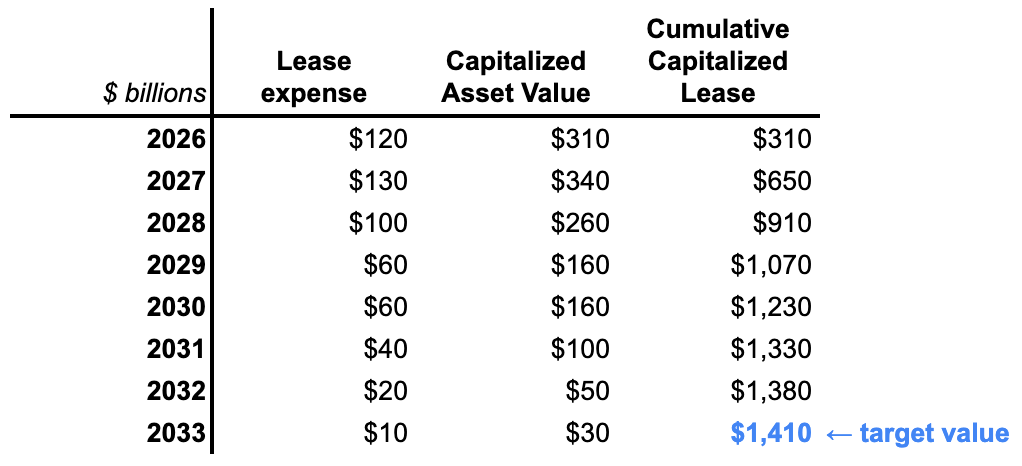
Note that OpenAI has committed to approximately $1.4 trillion in AI infrastructure, including data centers, over the next eight years to support future development. The keyword is “committed,” which we translated to mean capitalized lease commitments, not actual cash outlays.
2. Answer independence: Ads will not influence the answers ChatGPT gives you. Answers will be optimized based on what’s most helpful to users. Ads will be clearly separated and clearly labeled.
3. Conversation privacy: Conversations with ChatGPT remain private from advertisers, and we never sell your data to advertisers. This is absolutely key if OpenAI wants to create a giant economic moat. In other words, their positioning (water-tight-walled garden) is the polar opposite of the “open” Internet.
4. Choice and control: Users control how their data is used. Users can turn off personalization and can clear the data used for ads at any time.
5. Long-term value: OpenAI does not aim to optimize for time spent in ChatGPT. They prefer to prioritize user trust and user experience over revenue. Again, this is key because their atomic unit of production is trust. We translate this to align with Google’s philosophy that utility trumps time spent. As long as consumers use Google’s products like toothpaste (twice per day), growth and free cash flow are guaranteed.
A quick historical look at the expressions of advertising
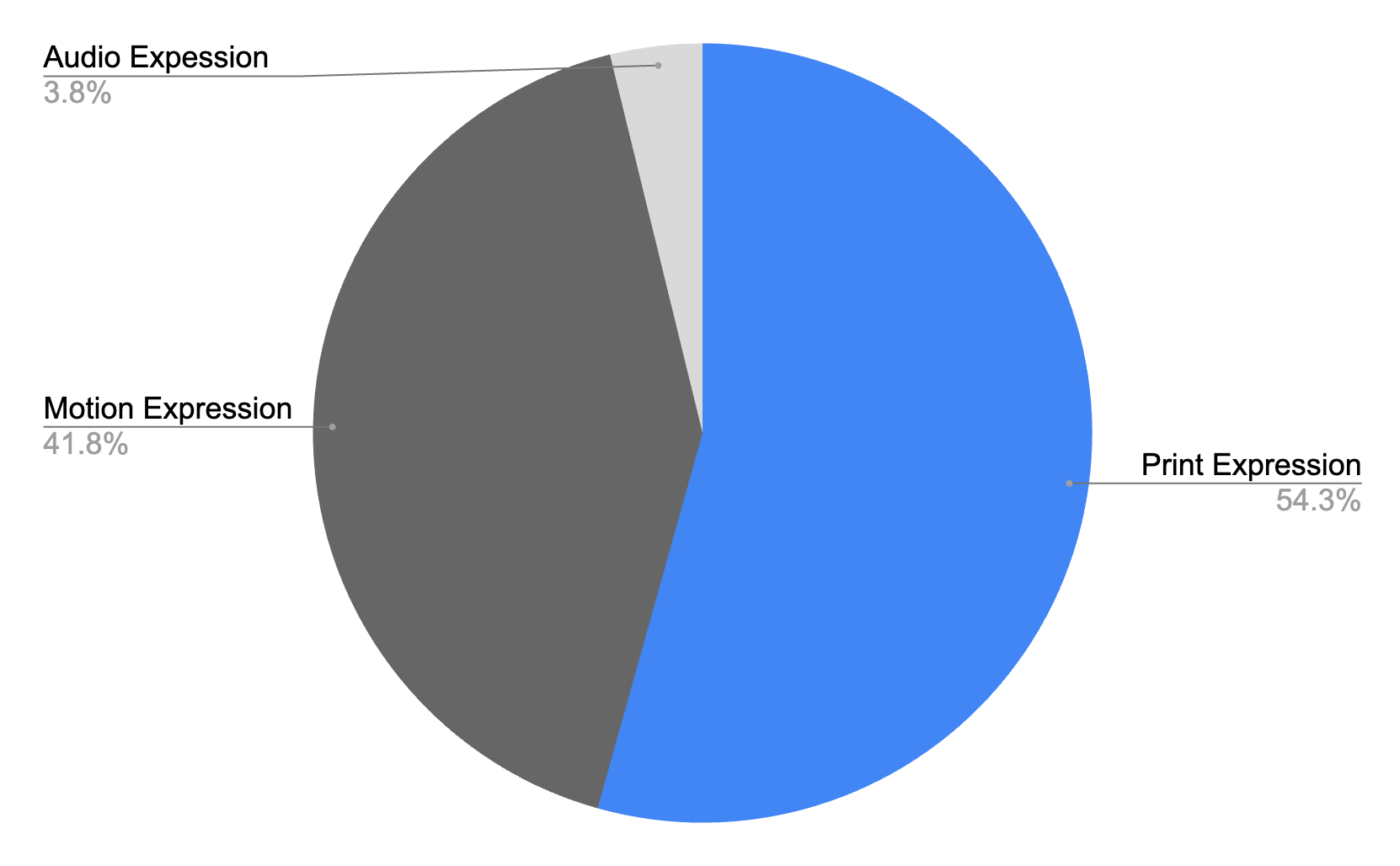
Despite constant innovation in media and technology over the past 5000 years, there are still only three fundamental expressions of advertising: print, audio, and motion (video). Therefore, every past and future adtech investment ultimately maps to one (or a combination) of these three.
As far as we know, print was the first expression of advertising and still dominates $1 trillion in media flows today. It appeared around 3000 BC and was found in the ruins of Thebes, Egypt. The ad was a papyrus print ad promoting a weaving workshop. Audio was the next expression of advertising in 700 BC China, where candy shop owners paid flute players to attract kids to the store.
Print is the original and still dominant expression (~54% of total ad spend). You can trace its roots from ancient written ads (e.g., early papyrus notices) through the Gutenberg press, early classifieds (Boston News-Letter, 1704), and the evolution from black-and-white to color posters via lithography.
Jumping forward to 1995, digital formats such as display, search, social (including influencer marketing), and retail media ads are mostly just continuations or branches of print. For example, search ads can be framed as a structured “directory” lineage (e.g., Yellow Pages), and retail media really just an evolution of catalog-style merchandising to meet online consumers where they are today.
Audio became the second major expression in the early 20th century, with the first radio commercial in 1922 by AT&T's WEAF station in New York City. It was a 10-minute commercial for the Queensboro Corporation, promoting apartments in Jackson Heights. The Queensboro Corporation paid $50 for the commercial.
Motion (video with audio) was the third expression to come onto the advertising scene. It started with silent-era theater ads (slides and pre-feature promotions) as early motion-era commercialization. The first U.S. TV ad in 1941 (for Bulova watches) was the beginning of modern televised advertising.
TV ad spend experienced hypergrowth in the 1970s and expanded again with cable ads in the 1980s. In 2026, we are well into the decade of CTV ad growth. It’s not a new expression, but rather a dollar-for-dollar migration within motion. Of the nearly $1 trillion in global ad spend in 2025, the majority is a print expression.
With our historical backdrop in mind, we can more clearly see how ChatGPT ads are unlikely create a new form of advertising. Far from it. The ad units will simply be an expression of print (similar to a sponsored listing), audio (when interfacing with ChatGPT via voice prompt and listening), or motion (a video ad experience inside chat results).
What’s Different: What will likely be different is how ads inside chatbot experiences represent a new division of labor (in the spirit of Adam Smith) by breaking the media and creative job-to-be-done into more atomic tasks to create new outcomes for advertisers. This atomic shift will change how advertising (media and creative) is produced, transacted, targeted, served, optimized, and measured with higher-calibrated instrumentation, but the underlying advertising expressions will remain print, audio, and motion.
ChatGPT Ads TAM Background
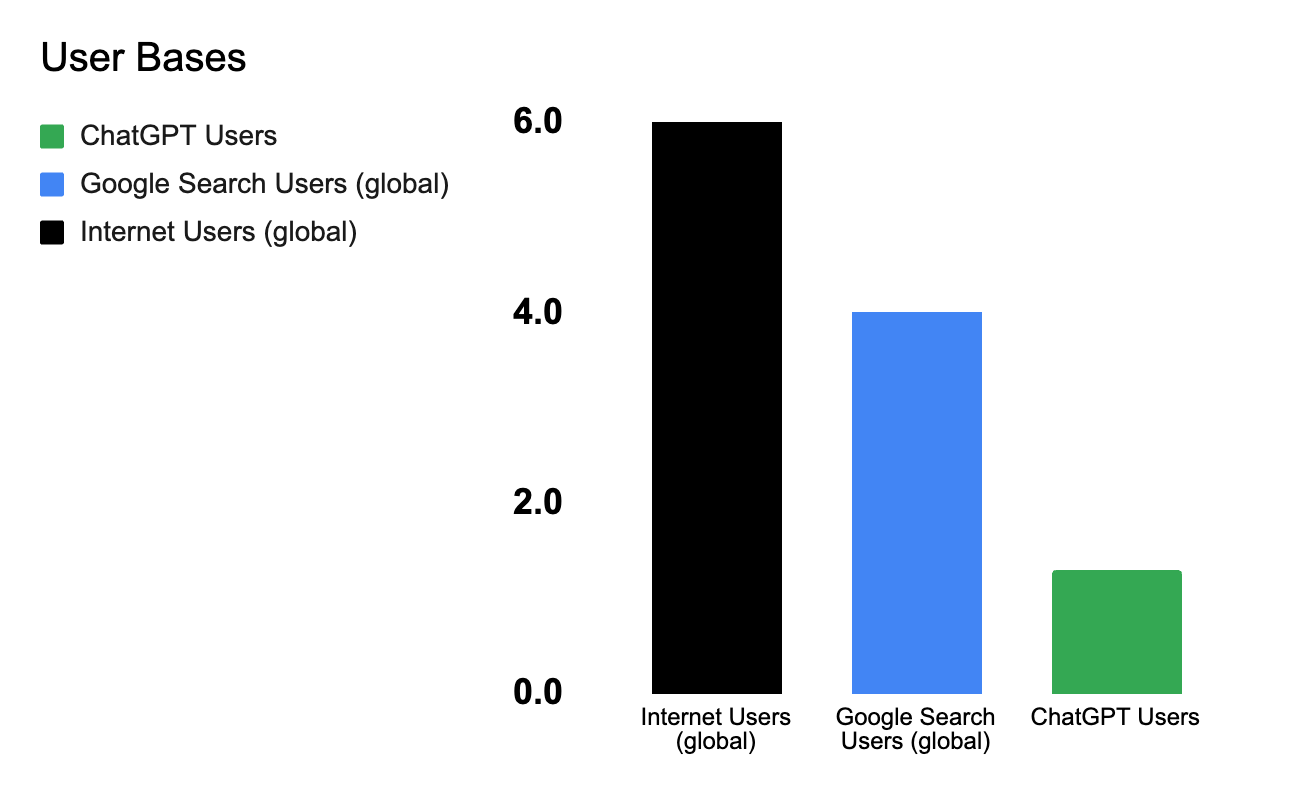
Back in 2000, it seemed like Google search came out of nowhere. Today, there are an estimated 6 billion internet users, and ~4 billion of them use Google search. Business models don’t get much more ubiquitous than that.
And according to various estimates, there are ~1.3 billion ChatGPT users, give or take. As of late 2025, the official ChatGPT mobile app has achieved massive adoption, with approximately 1.36 billion cumulative global downloads since its launch in May 2023.
Google is the top candidate for the most amazing business ever created. Microsoft is probably a close second. Back in the early 80s, IBM did not fully appreciate the strategy of Bill Gates, Paul Allen, and Steve Ballmer. They simply failed to see how Microsoft would create a massive and enduring economic moat that it still enjoys today.
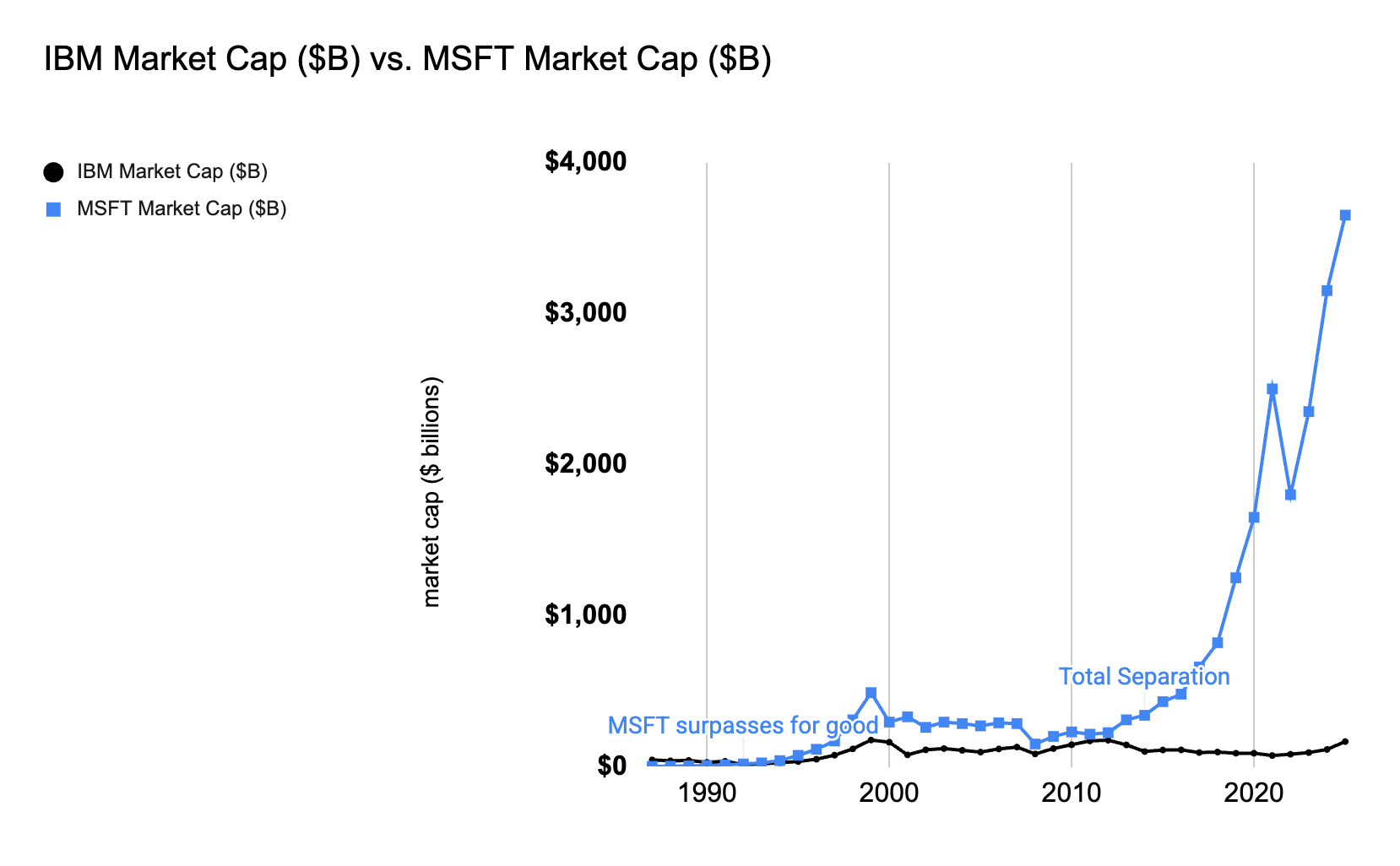
Moral of the Story: Just because Google is so dominant today, like IBM was in 1980, doesn't mean it will be dominant forever. Why? Because there is always a 100% chance of disruption, and it is highly probable that a substitute or new entrant will eventually come along. From what we can observe, the most likely new player in town is OpenAI.
Sizing The Opportunity
If you work in advertising and use ChatGPT, you’re probably envisioning and discussing what these future ad experiences will look like. As far as we can tell, it is reasonable to think of ChatGPT ad experiences as a substitute good for search.
Assuming such a comparison makes sense, we looked at Google search growth since 1999 and built a best-fit diffusion curve model through 2025.
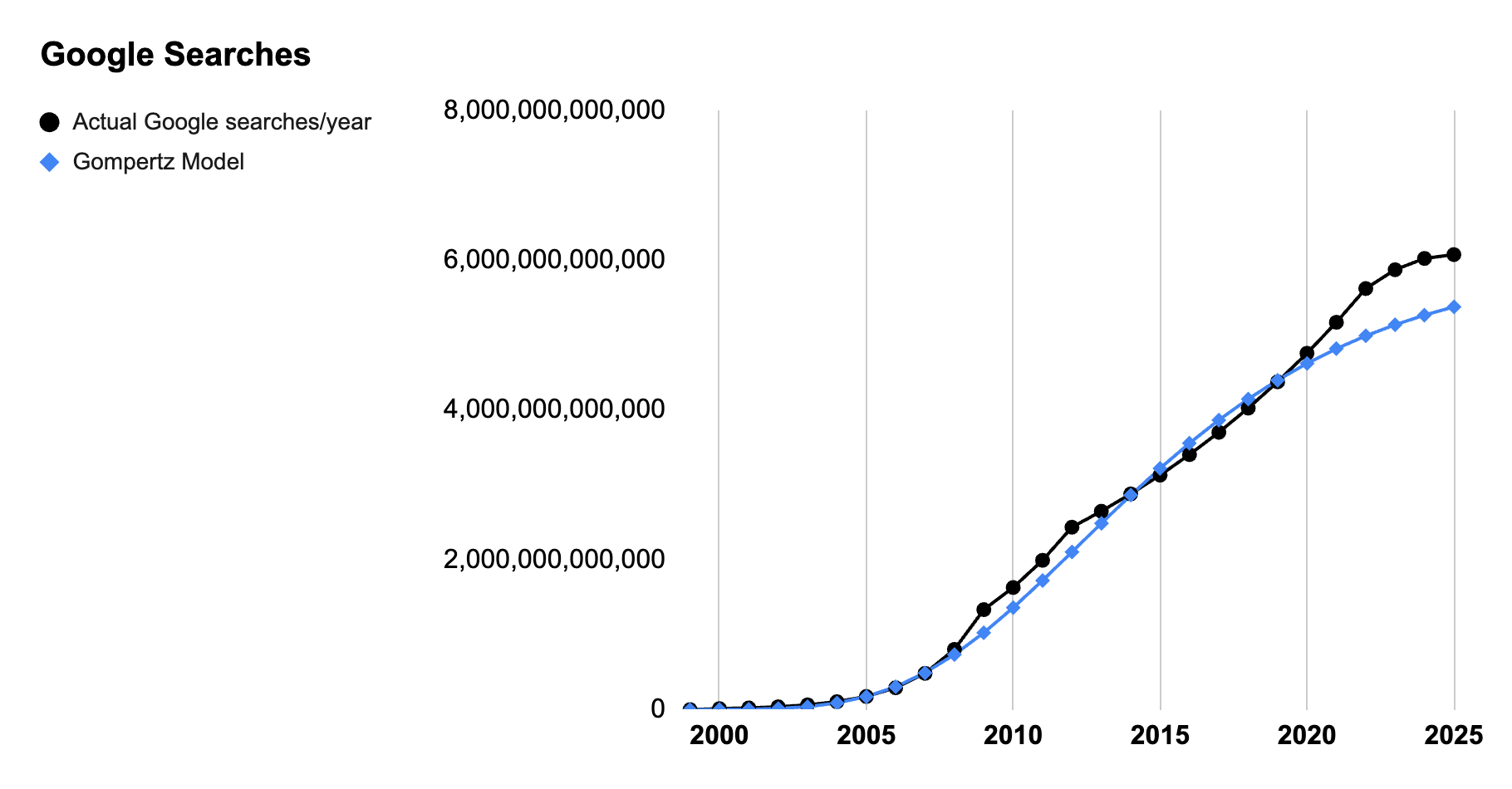
If you’re interested, here’s our best-fit Gompertz model:
We were unable to locate historical data on Google Search users; however, available reports suggest the average user conducted roughly four searches per day in 2025. We use 4.0 searches/day as a reasonable 2025 proxy and built a best-fit model such that 2.0 searches/day occured around 2011 (blue curve below). This is when Larry Page first publicly discussed the “toothbrush” strategy during Google’s second-quarter earnings conference call. During the call, Page outlined his goal to create services that people use “twice a day, just like a toothbrush.”
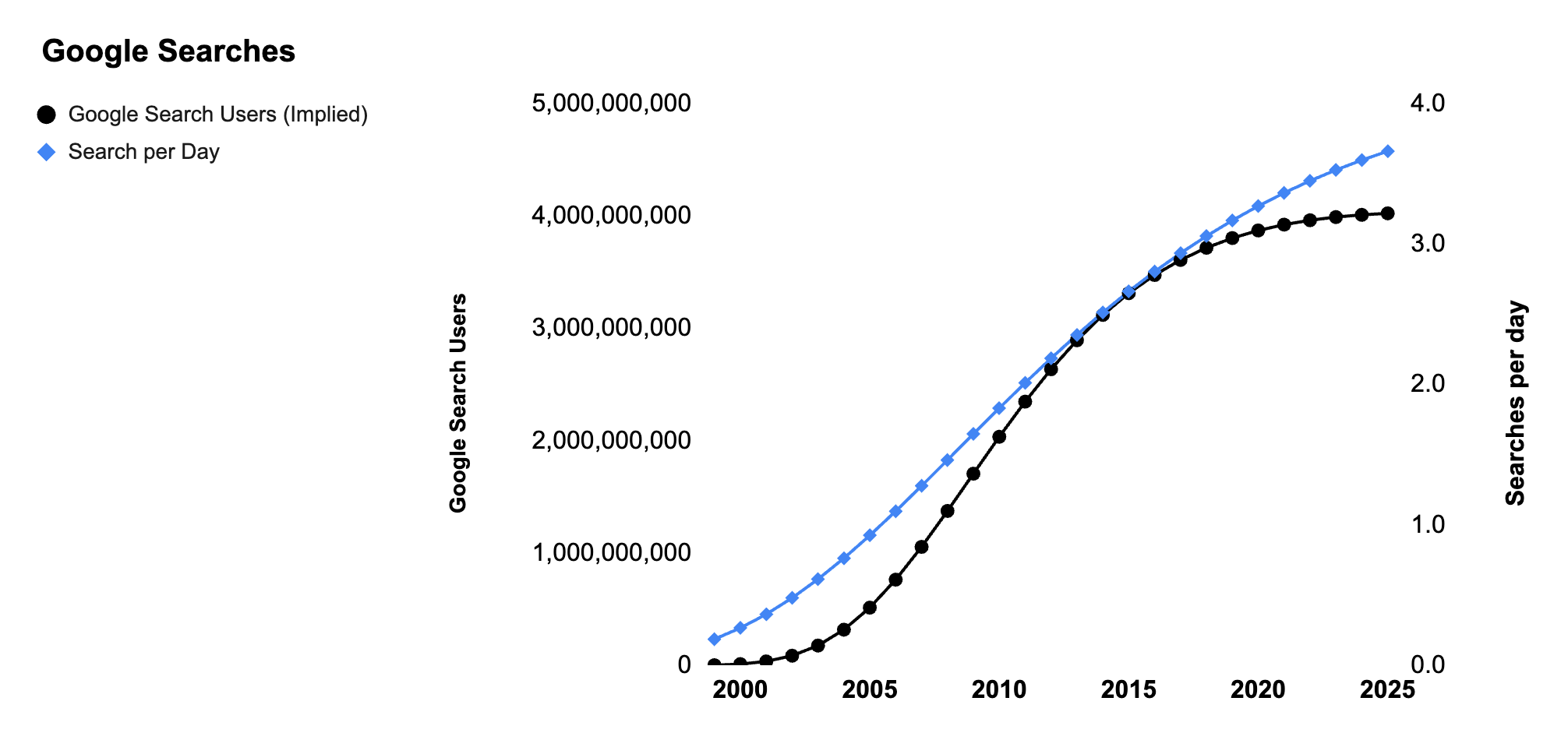
With a decent time-series growth in Google searches and another curve for searches/day, we derived the number of Google users over time and estimate there ~4 billion users today.
Mapping ChatGPT to Google’s Past Experience
Now that we have a decent baseline for imagining ChatGPT’s ad market size, our next step is to compare the first four years of Google’s search user growth (1999 to 2002) with ChatGPT's first four years of user growth (2022 to present). From there, we can construct an addressable market for ChatGPT.
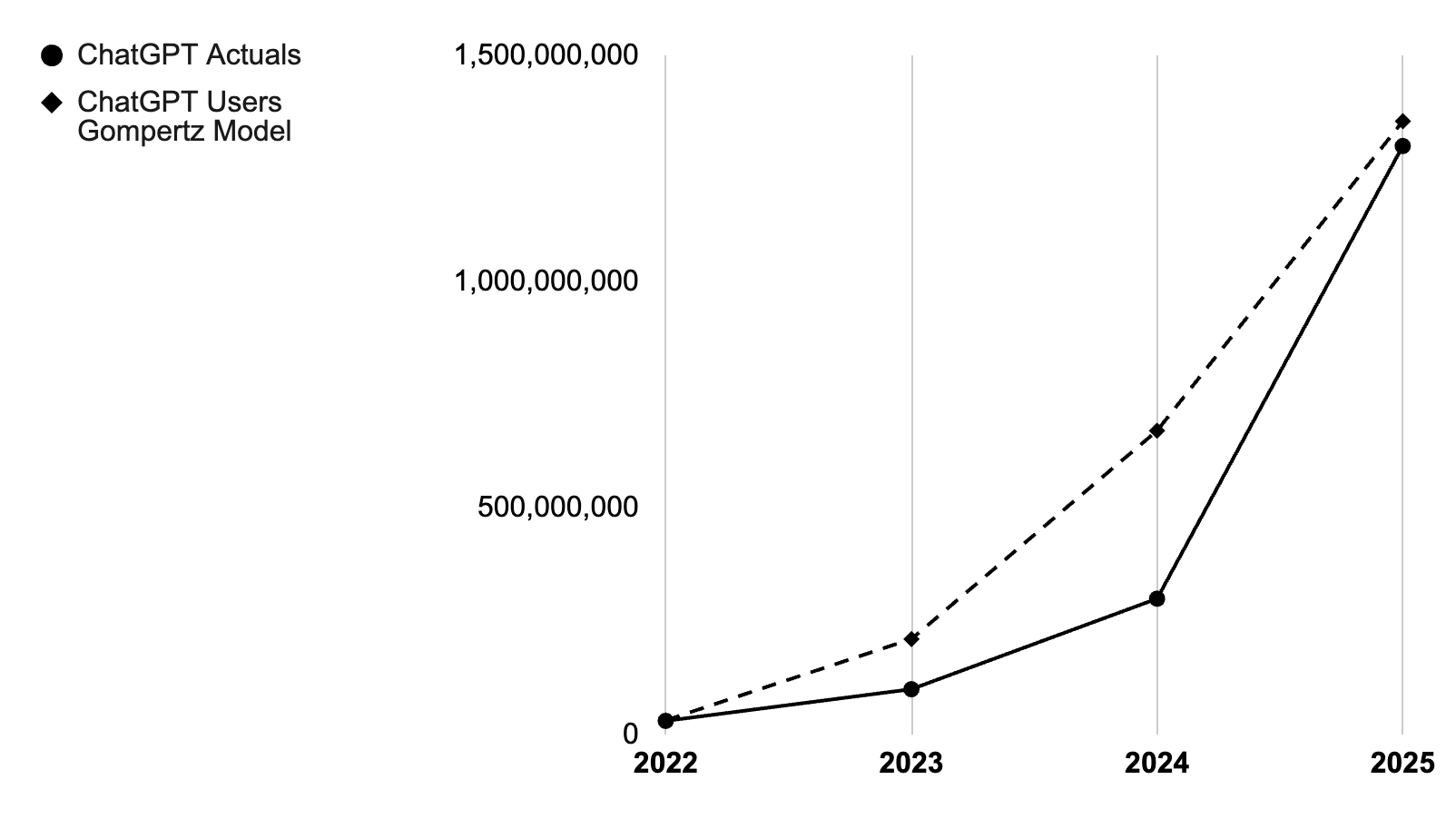
Our model estimates that Google had 88 million unique users in its fourth year of life in 2002. Keep in mind, the Internet was still quite young in 2002 with a meaningful portion of people (young, old, 2nd and 3rd world countries, etc.) still not online. Back then, only 10% of the globe was online compared to 70% today.
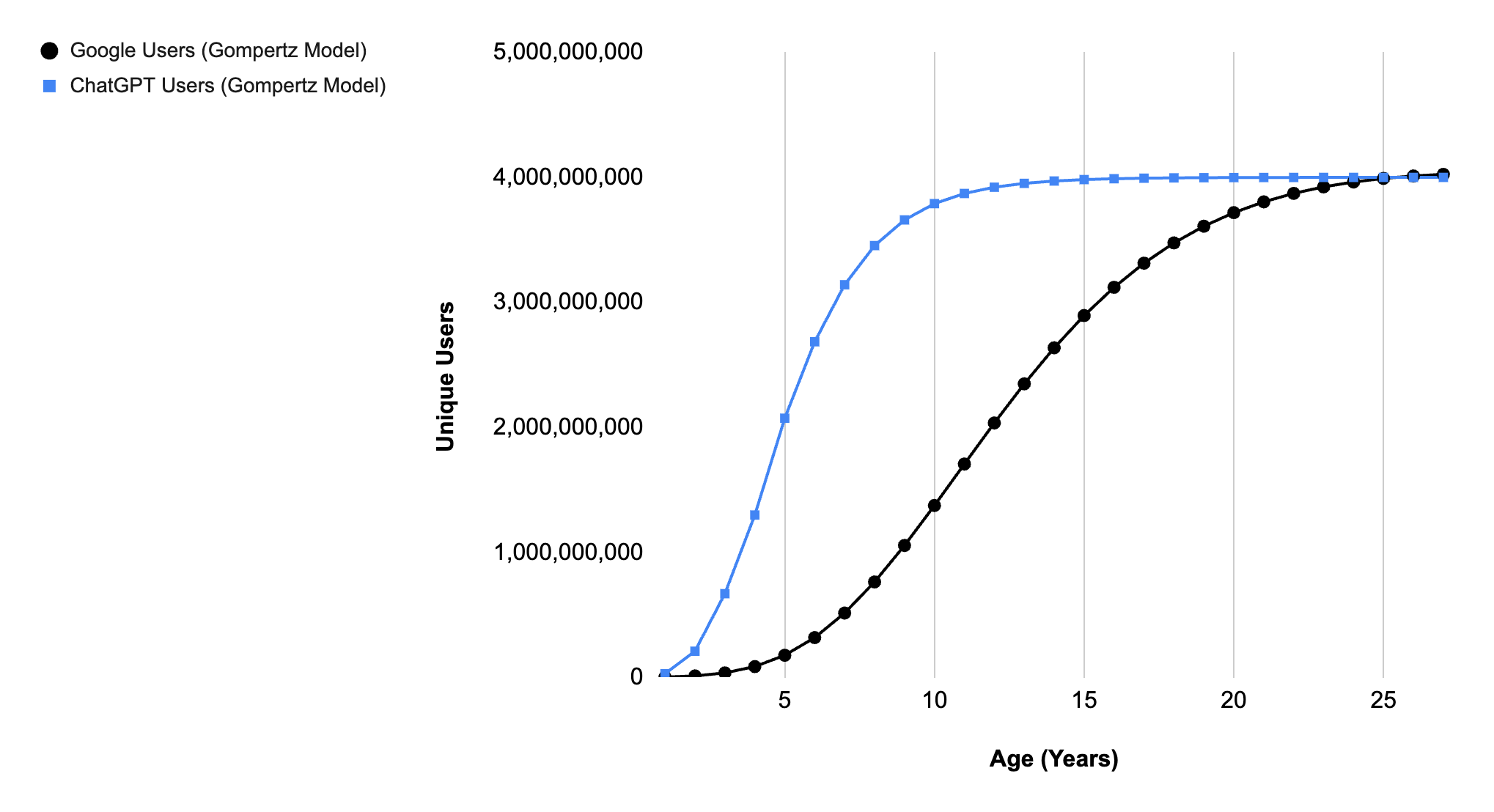
In 2025, ChatGPT’s fourth year of life, it had over 1 billion unique users. If we update our model parameters to account for faster growth across a much bigger Internet install base compared to when Google started (the blue line), we can imagine ChatGPT scaling new users much faster than anything that has come before it. We don’t think such an acceclerated curve should be surprising to see because new technology cycles tend to compress adoption timelines, leading to faster adoption toward a maturity limit defined by the number of global internet users.
Forecasting ChatGPT DAU, Prompts per Day, and ChatGPT Revenue
With an estimate of unique users on the table, we convert it into an estimate of daily active users (DAU) using a factor of 15% (e.g., 15% of annual uniques converts to DAU).
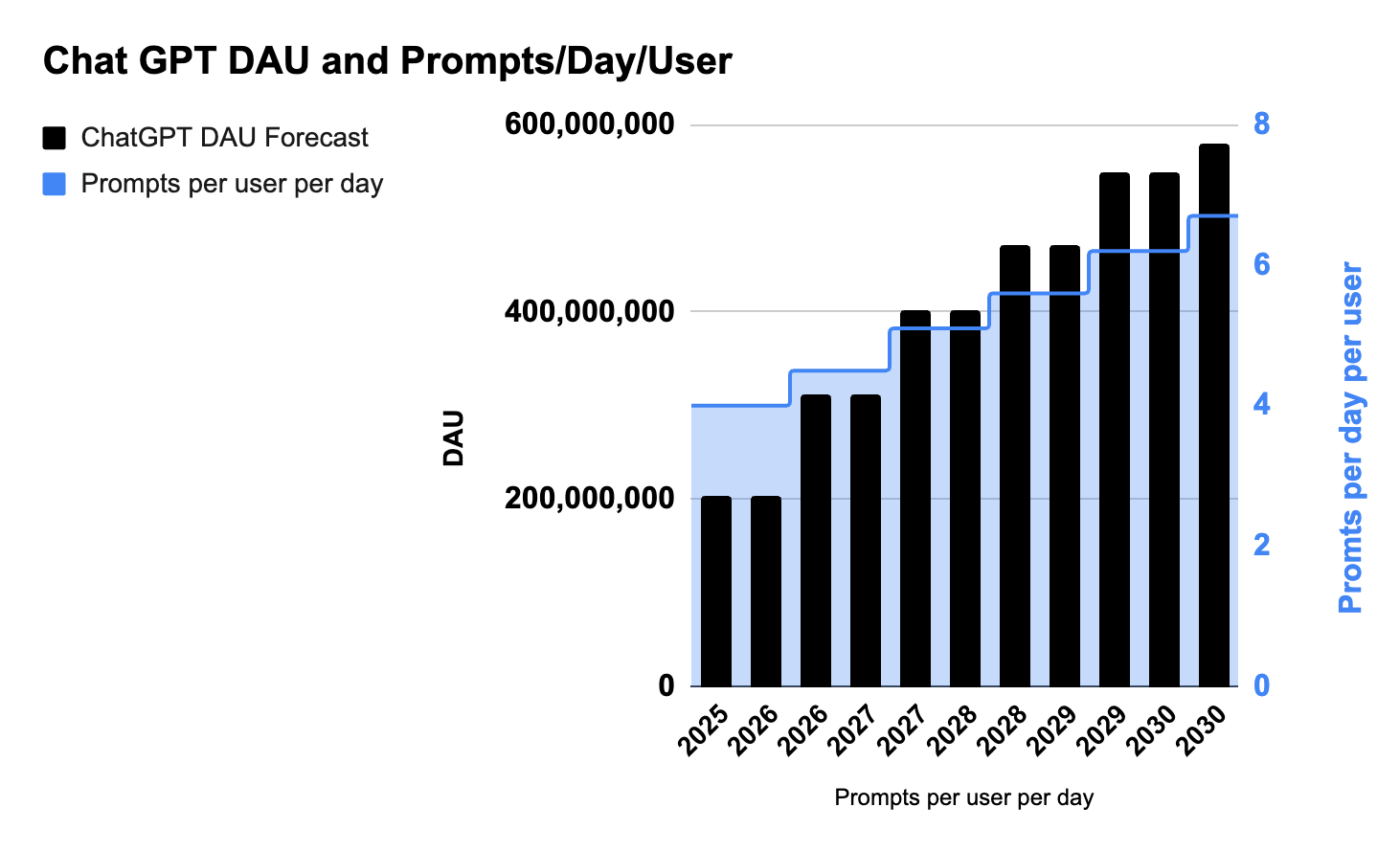
We then asked ChatGPT: How many chatGPT queries or prompts to does the average user do per day?
Answer: On the order of ~3–5 prompts per user per day.
We use 4 promts per user per day as the mid-point starting value in 2026 and step up to 10 per day as a terminal value when adoption reaches maturital around 10 to 15 years from now (maybe sooner).
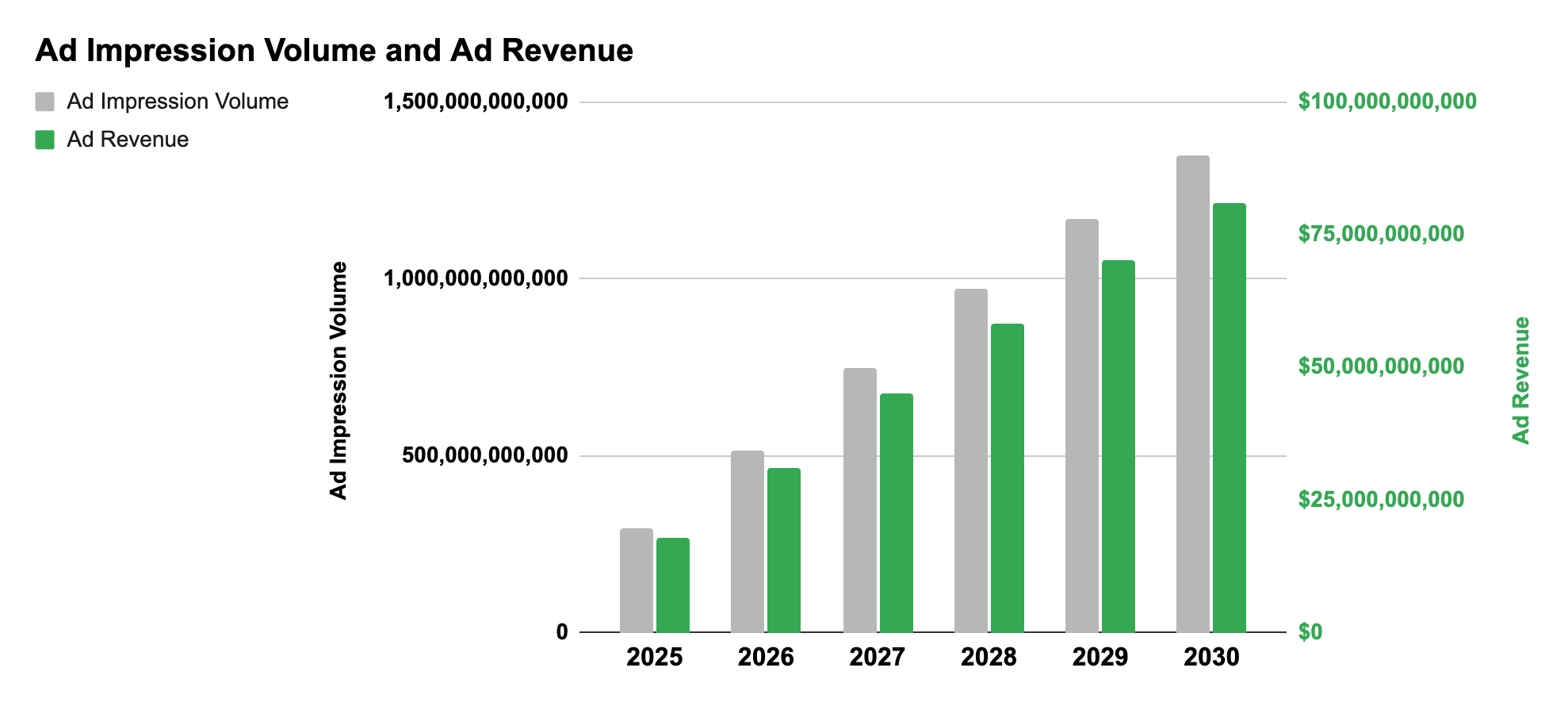
On average, advertisers pay Google search a $2.69 CPC and expect to achieve an average 3.17% CTR. That equates to an $85 eCPM. According to OpenAI, they are aiming for $60 CPM.
If we take these plugs as face value, our model suggests ChatGPT’s revenue could be $17 billion in 2026 and grow to $80 billion in 2030 based on five prompts per user per day. At maturity, our model suggests $160 billion at a $60 CPM and $185 billion at an $85 CPM.
To our forecsat into perspective, if Google search revenue grows at a 7% CAGR over the next 5 years (conservative), it will generate a whopping $310 billion. $80 billion, ChatGPT would sixth largest media channel.

Disclaimer: This post, and any other post from Quo Vadis, should not be considered investment advice. This content is for informational purposes only. You should not construe this information, or any other material from Quo Vadis, as investment, financial, or any other form of advice.
Good point. What I'm wondering is if ChatGPT ads will get better CTR than Google search, independent of placement.
Interesting and likely way to optimistic. Let's say you are right, and they manage to build a meaningful ads business at $80B/yr, the main thing that pops out is the massive gap between what infrastructure cost commitments are, and revenue.
I can't get Altman's statement that "ads are a last resort" out of my head. What does this say about the state of OpenAi's ability to monetize?