
#CannesLions is around the corner! If you are interested or invested in the commerce media space, then join our string of events with Fluent, Inc., and Landmark Ventures as part of your weeklong Cannes journey. You can RSVP here.
And if you’re interested in How Agencies Win in the AI Era: Automation, Intelligence & Growth join my exclusive breakfast session at Belle Plage Beach Club with John Kahn (Chief Transformation Officer, Digitas North America), Domenic Venuto (Chief Product & Data Officer, Horizon Media) and Jeet Singh (Founder, AtomicAds) exploring how AI agents and automation are reshaping agency models, media operations, and future growth. You can RSVP here.
Publicis Acquires Liveramp for $2.2B (EV)
The timing of this news could not be better for a story Quo Vadis has been toying with over the past few months. From our perspective, we think Publicis’s string of acquisitions that now include Liveramp (Influencial, Captiv8, Lotame, Fabric Social, Adge.ai, etc.) is less a story about buying an identity asset and more a story about moving further away from being a farmer on behalf of advertisers toward landownership and controllership of fertile land (data) upon which the best advertising output grows. With that in mind, here’s a story about a farming town called Adwell Hollow.
Part 1: The Landowners of Adwell Hollow
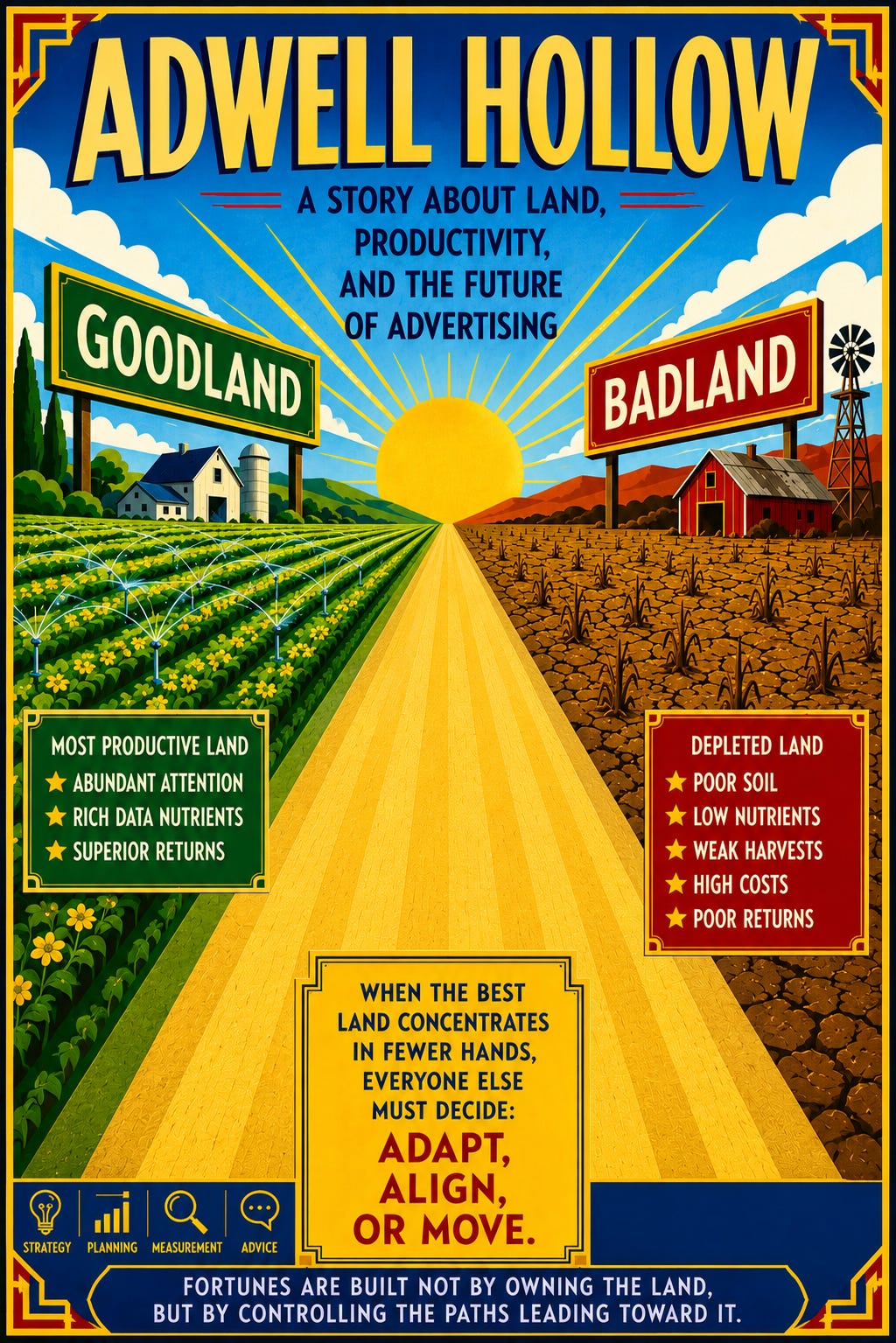
In a small farming town called Adwell Hollow, there were two neighboring landowners whose fields stretched farther than the eye could see. Long ago, both properties had nearly identical soil. The land was fertile and rich with productive possibilities.
The first landowner, Elias, believed land was a responsibility. He tested the soil, replenished nutrients, built irrigation systems, rotated crops, and studied what allowed harvests to improve year after year. To him, fertile land was not inherited; it was an asset to be maintained.
The second landowner, Rowan, believed land was simply acreage. His responsibility ended once rent was collected from farmers. Irrigation channels cracked, soil nutrients were depleted, overplanting was allowed, and weeds spread. Even though productivity for his tenant farmers kept falling, he always had farmers willing to rent his land. Not because the land was good, but because farmers always needed land to farm one way or the other.
Around Adwell Hollow lived ten farmers. Each planting season, they priced and competed to rent land. Over time, more farmers offered higher rent to work Elias’s fields. Even though it was more expensive, the fertile land produced greater harvests than Rowan’s cheap, exhausted land.
Over time, the road leading to Rowan’s inferior land became crowded with merchants selling plows, fertilizers, tools, and miracle devices promising larger harvests from weaker soil. Entire businesses emerged around helping farmers endure these increasingly difficult conditions.
Eventually, these middlemen merchants formed farming guilds, and farmers hired them for advice. The guilds studied yields, negotiated leases, planned planting schedules, and recommended tools. The poorer the soil became, the more valuable the guilds appeared. Complexity was their livelihood.
The guilds prospered for many years, but then something changed. More farmers began choosing Elias’s land despite having to pay higher rents. They discovered that healthy soil mattered more than sophisticated techniques.
The guild leaders grew uneasy. “If farmers increasingly move toward fertile land,” one elder asked, “what will become of us?”
A younger guild member answered: “For years, we have helped farmers with increasingly difficult land. Perhaps our future is not in helping them survive poor fields, but in moving closer to fertile ones.”
The room went quiet. “What if we build the irrigation systems feeding fertile land?” she continued. “Or the grain exchanges where harvests are traded. Or the storage houses. Or the maps measuring soil quality before farmers decide where to plant.”
Years passed. Every so often, the farmers put guilds into review and picked a new one, but they all seemed the same. Some guilds simply disappeared in their efforts to defend old work, while others gained enlightenment and transformed. The most valuable guilds no longer earned their living helping farmers extract one more basket from exhausted soil. Instead, they acquired and owned the roads, water systems, and marketplaces through which every successful harvest eventually flowed.
In the end, the people of Adwell Hollow learned something unexpected. When wealth concentrates around fertile land, other fortunes are built not by owning the land itself, but by controlling the paths leading toward it.
Part II: The Great Consolidation of Adwell Hollow
Years passed in Adwell Hollow, and a pattern became difficult to ignore as farmers increasingly chose fertile land. Elias’s fields commanded higher rents each season, yet demand continued to rise because the soil produced more outcomes than it consumed.
Meanwhile, Rowan’s land struggled. More merchants appeared along the roads selling improved tools for difficult farming, while new guilds offered all kinds of optimization services. The work that went into poor soil multiplied even though harvest outcomes did not.
Then something unexpected happened. The town entered an age that the people would later call The Great Consolidation.
A small irrigation company was purchased by a farming guild seeking greater influence over yields. A grain storage operator merged with a transport business to control more of the route between the field and the market. Some guilds purchased soil-testing businesses so their recommendations would become indispensable.
In hindsight, the smartest consolidators did not purchase land. Those who owned the best farming land would never sell it. So instead, they purchased control points surrounding productive land.
Then came another wave. Rowan, whose fields had continued deteriorating, began buying neighboring plots with even poorer soil. The townspeople were confused. “Why acquire worse land?” they asked. The answer was simple: “More acreage means more farmers,” Rowan said. “And more farmers mean more rent.” Whether harvests improved was a secondary consideration.
For a while, Rowan’s strategy worked. Rowan’s territory expanded, more merchants lined the roads, more tool providers sold more picks and shovels, and activity increased.
Yet beneath the surface, something strange occurred. The town became busier while overall harvest quality stagnated. How could that be?
As economic activity and economic productivity slowly separated, a new generation of guild leaders studied Elias’ principles and noticed something important. The greatest fortunes accumulating around fertile land were not necessarily those of the landowners themselves, but were increasingly held by those who controlled irrigation, logistics, financing, measurement, or storage.
A debate emerged among the guilds. One side argued, “We should continue helping farmers survive difficult land.” And another argued, “We should acquire the systems through which all successful farming flows. We need to get closer to the flow of value.”
The second group had more conviction and began buying aggressively. One purchased water rights. Another bought the town’s crop exchange. Another merged with storage operators. Another acquired transportation routes connecting farms to markets. The best assets rose to the top, with many little gems also finding their way to greener pastures.
Years later, those acquisitions transformed the town. The most valuable institutions in Adwell Hollow were no longer advisers who charged fees for their labor. As it turns out, infrastructure, the town learned, captures rent long after individual harvests are forgotten. While the old guilds believed value came from working harder around weak soil, the new guilds understood that when fertile land wins the day, survival and value creation depend on buying your way closer to the flow of value.
Student Notes
Adwell Hollow —The Advertising Industry
Elias — Google, Meta, and the Keepers of Fertile Land
Rowan — The Open Web
The Farmers — Advertisers
The Farming Guilds —Advertising Agencies
The Guild Elders —Defenders of Legacy Models
The Younger Guild Members — Those Willing to Move Closer to Value
The Merchants of the Road — AdTech Vendors
Picks & Shovels — Measurement, Identity, Verification, Optimization, Tools
The Soil —Consumer Attention
The Nutrients — Data and Connected Cata
Irrigation Systems — AI, Algorithms, Infrastructure
Healthy Harvests —Economic Returns
Harvest Failure — Weak Outcomes Despite Activity (busy work)
The Roads — Distribution
Storage Houses — Customer Data & Commerce
The Crop Exchanges — Marketplaces
The Soil Maps — Identity Resolution & Measurement
Buying Better Irrigation — Strategic M&A
Buying Worse Land —Open Web Scale Without Productivity (aka “cheap reach”)
The Great Consolidation — Advertising M&A (Past, Present & Future)
Guilds with Conviction — Publicis
The Smartest Consolidators —Those Buying Control Points
The Real Estate Closest to Fertile Land — The Future
Special Thanks to David Ricardo, Adam Smith, Warren Buffett, The Open Web, Compounding Returns, and Incentives, with a focus on maximizing economic profits.
Disclaimer: This post, and any other post from Quo Vadis, should not be considered investment advice. This content is for informational purposes only. You should not construe this information, or any other material from Quo Vadis, as investment, financial, or any other form of advice.
Great question Mike. That’s precisely the lens I was hoping to create with this piece. Magnite started out by playing on the road to Rowan’s poor land, e.g., cheap reach supply which was driven my marketing procurement’s need for low CPMs while not caring about quality. That’s business never generated positive economic returns. With Springserve and other smart moves, Magnite now plays on the road around Elias’s land, (but still works on poor land too), which is a way better place to me and it is showing up in their financials results.
Great piece Tom. One Q on the framework (if I may!)...
Where do you place SSPs like Magnite that have exclusive infrastructure deals with new walled gardens (Pinterest, X, Best Buy etc) and are the sole programmatic access point for CTV publishers who tightly control their first-party data? Are they merchants on the road to Rowan's land, or are they building the irrigation systems for Elias's fertile fields?
Curious whether you see a distinction between open display SSPs and those with locked-in sell-side control points in CTV/commerce media.