
#157: Where Media Money Wants to Go
Article #1 in our Quo Vadis series, Mental Models for Modern Advertising. A first-principles exploration of how markets, founders and products shape the future of value creation.
If you enjoy fall baseball, big ideas, and great conversations with smart people, you might want to join Landmark Ventures SMART Summit on Tuesday, September 22. Landmark Ventures will host an invitation-only gathering at Yankee Stadium, bringing together 150 senior executives across Sports, Media, Advertising, Retail and Technology to discuss the forces reshaping our industry, from AI and agentic workflows to commerce media, identity, measurement, audience engagement, and M&A.
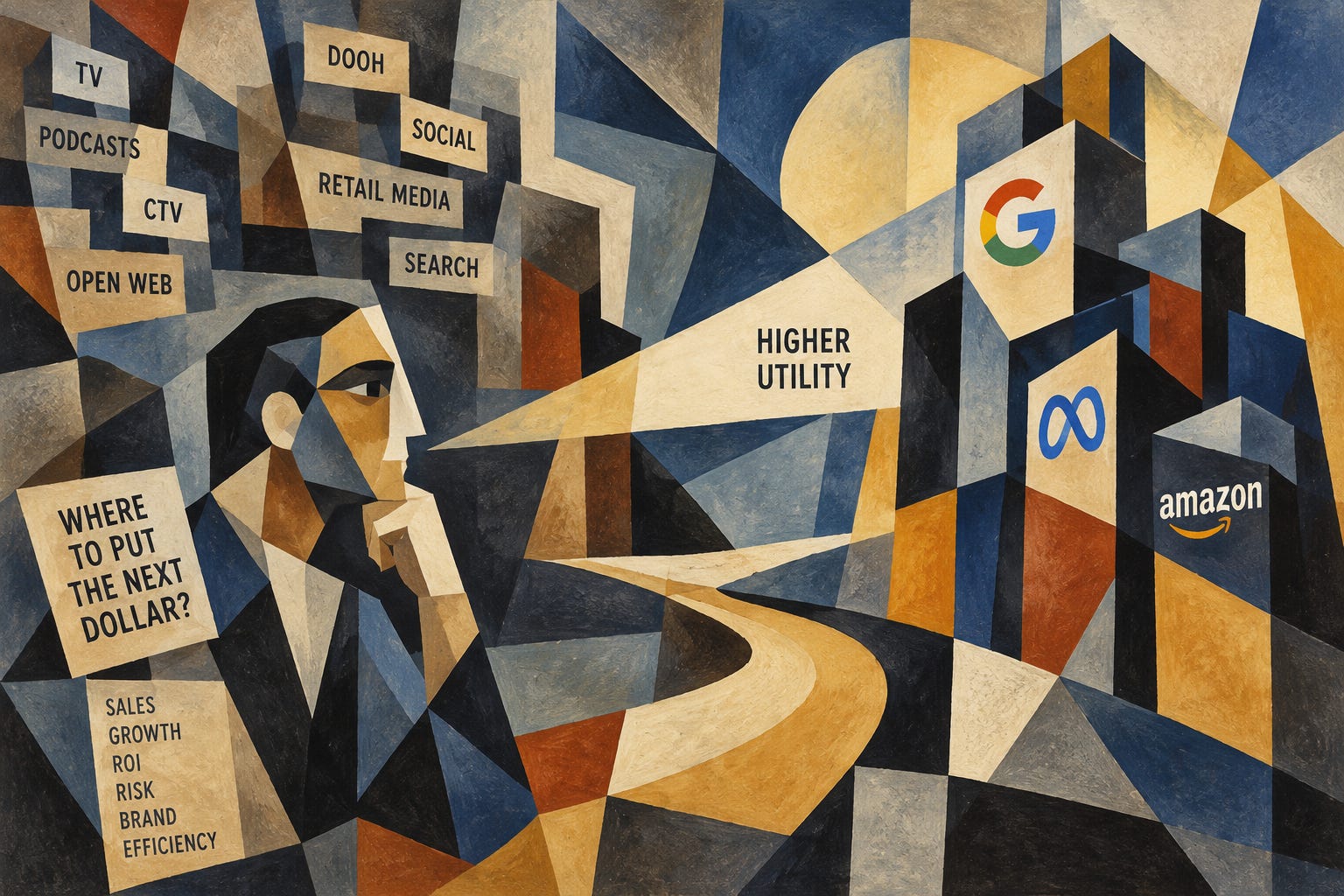
Where Media Money Wants to Go
Let’s make a claim:
Advertising is not a marketplace for media. It is really just a marketplace for capital allocation.
People often describe advertising as a media business. That’s understandable because we talk about television, search, social media, retail media, connected TV, podcasts, digital out-of-home and the open web as though they are separate markets competing against one another.
However, that perspective only looks at the industry from a supplier’s viewpoint (echo chamber) because marketers don’t wake up thinking about media. They wake up thinking about where and how to allocate capital. Whether they articulate it that way or not, every marketing decision is ultimately an exercise in capital allocation.
From the firm’s perspective, advertising is simply one of the places where capital is invested in the expectation of generating a return. Seen through that lens, the size of the opportunity becomes much clearer. Global media spending is around $1.2 trillion annually, and current growth rates suggest another half-trillion dollars or more will enter the market over the next five years.
Every one of those new dollars has to find a home. That raises a more interesting question than which company will win share. The real question is:
Why one destination attracts capital while another does not?
Importantly, capital rarely moves because someone built a slightly better product. It moves because the expected utility (aka outcomes) of one alternative becomes greater than that of another, and the word “utility” is whatever the marketer in question wants it to be (e.g., sales, looking risk aversion, etc.).
This helps explain why marketers increasingly choose platforms like Google, Meta and Amazon even when those platforms don’t provide visibility into how every advertising dollar is spent. Budgets continue to migrate toward products such as Google Performance Max, Meta Advantage+ and Amazon’s AI-powered advertising solutions. In essence, advertisers simply specify an objective and let the platform optimize toward the desired outcome.
The latest 2Q26 results reinforce this point. Google, Meta and Amazon didn’t report outstanding quarters simply because they sold more advertising inventory. They reported outstanding quarters because marketers entrusted them with more capital. In all three cases, they are finding ways to squeeze more value out of their current supply while simultaneously adding new supply vis-à-vis new user growth.
Meta continued to demonstrate how AI is increasing the economic output of every user session by simultaneously expanding engagement, advertising inventory, and pricing.
Google showed similar momentum through AI-powered Search and Performance Max.
Amazon once again delivered robust advertising growth by leveraging its commerce and retail media ecosystem to produce more marginal utility for advertisers.
Three different companies with three different products, operating the same underlying economic principle:
Capital flows toward the alternatives that offer marketers the highest expected utility.
There is another characteristic these three companies share that often goes unnoticed. They not only produce attractive outcomes, but they also make capital remarkably easy to deploy. Each presents marketers with a largely orchestrated system in which planning, audiences, measurement, optimization, and execution work together as a single experience.
By contrast, the open web contains world-class companies at nearly every layer of the advertising stack, yet those capabilities remain distributed across a highly fragmented ecosystem. The individual components are impressive, but the system as a whole is not. It’s the difference between owning every instrument needed for a symphony and having an orchestra capable of performing one. In other words, marketers don’t want to allocate capital to individual instruments when they can allocate capital to get the entire performance. Delivering a total performance requires coordination, which is precisely where the open web struggles to compete.
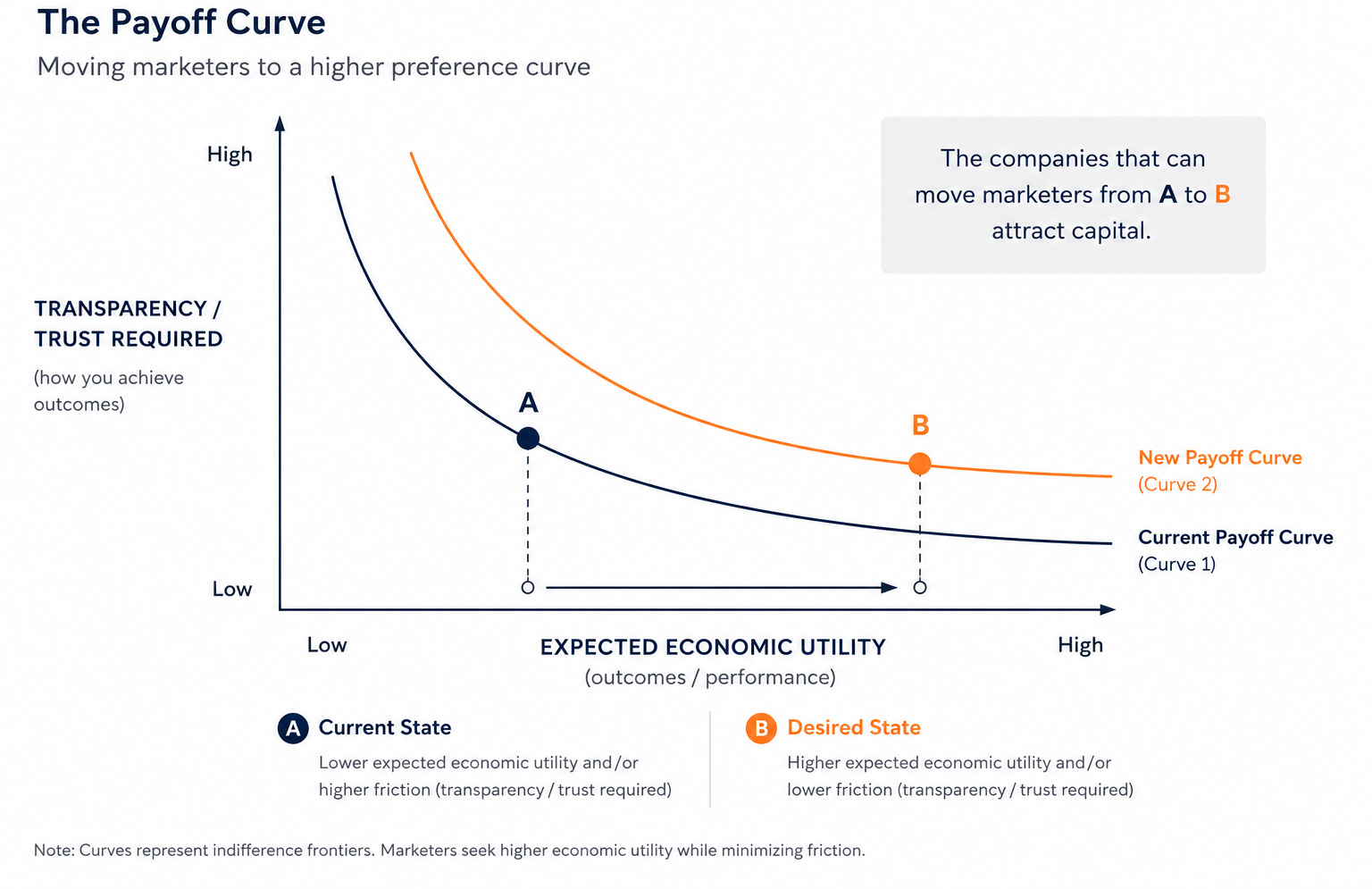
From a marketer's perspective, deploying capital across the open web ecosystem requires far more coordination, integration and trust than deploying it inside a single platform. In that regard, capital tends not only to seek better outcomes but also to seek the lowest friction. If the reinvented next iteration of open web advertising is going to win more in the future (e.g., AdCP, buyer-seller agents), it must figure out how to coordinate and orchestrate to remove all the friction and make better music.
A Word On “Transparency”
At first glance, all the money flowing to nontransparent platforms appears to contradict years of industry discussion and marketers' claims about the need for more transparency. In reality, this dichotomy reveals something more fundamental.
Most marketers talk about transparency, but they never actually think about purchasing transparency. Instead, they purchase confidence that their capital will increasingly produce better business outcomes.
Transparency was never the objective (nor will it ever be). Transparency is simply one mechanism for building confidence between counterparties. However, if a black-box system consistently delivers superior outcomes, marketers will often place more trust in that system than in a fully transparent one that produces inferior results. In the real world of capital allocation, marketers don't think about rewarding transparency. They reward confidence, which is ultimately earned through performance.
Capital Allocation and Competition
Thinking in terms of capital allocation also changes how we define competition. Reed Hastings once remarked that Netflix’s primary competitors were not Hulu or Amazon Prime Video. In his astute view, the competition for Netflix is sleeping and gaming. His point was that competition should be defined by what customers choose instead, not by companies that happen to look similar.
Advertising technology across the open web faces a similar challenge. The competitive set for an independent adtech company is not another DSP, SSP, or identity provider. That’s a zero-sum game. Competition for open web adtech is the collection of alternatives that make it easier for marketers to deploy capital with confidence.
Sometimes those alternatives are Google, Meta or Amazon. And sometimes they are internal marketing teams, retail media networks, or increasingly AI-powered buying systems. The key point is that the labels matter less than the marketer’s next-best choice.
Seeing advertising through the lens of capital allocation changes how every company should think about its business. If marketers are allocating capital rather than buying media, then every company (particularly open web adtech) should spend less time defining itself by its product category and more time understanding the utility it creates (if any at all). You can talk about features as much as you want, but if you’re not communicating and selling benefits (aka utility), then your real addressable market is zero.
The Winners
The winners will almost certainly not be those offering the most features or the greatest transparency. The winners will be those who consistently move marketers onto a higher payoff curve by producing better outcomes with less effort and greater confidence.
While the advertising industry may seem like a marketplace for media, it is more accurate to describe it as a marketplace for capital seeking its highest expected return. That's a subtle distinction, but it changes everything. Companies (product, sales/marketing and leadership) that understand this concept will stop asking how to sell more media and start asking a much better question:
How do we become the easiest and most confident place for marketers to put their next dollar?
The Quo Vadis Lens
Illustration of how capital seeks higher utility: Every advertising decision is a capital allocation decision. Marketers will tend to choose the alternative that they believe will maximize expected utility, whether that means more sales, lower risk, greater convenience, or better performance.
Disclaimer: This post, and any other post from Quo Vadis, should not be considered investment advice. This content is for informational purposes only. You should not construe this information, or any other material from Quo Vadis, as investment, financial, or any other form of advice.