
#146: Sizing OpenAI's Ad Business
What OpenAI's Investor Valuation Implies; Google and Meta as "Gold Standard" Comps; A Quo Vadis tool to check your own assumptions about OpenAI's future ad business.
Note: This posts comes with a special tool for you to input your own values and think through what OpenAI’s future ad business will look like. Get the link at the bottom of the post.
One of the biggest topics across the advertising industry is the potential scale of OpenAI’s advertising business. Late last week, Axios reported the scoop that the company projects $2.5 billion in ad revenue this year and $100 billion by 2030. Reaching $100 billion over the next five years would mean OpenAI is the fastest-growing company in the history of advertising. Whether reaching such an amazing achievement is plausible, possible, or probable is what we cover in this post.
In January, Quo Vadis used Google search usage history and diffusion curve modeling to estimate $80 billion in 2030 ad revenue for OpenAI. A few weeks ago, Madison and Wall used headcount comparables and estimated that:
“OpenAI has the underlying scale to support as much as $3 billion in global ad revenue this year and significantly more in 2027.”
What do we know?
Let’s start with what we know or believe to be true.
Valuation: We know that investors valued OpenAI at $852 billion in its last financing round (post-money).
Comparables: We believe the two closest historical comparables investors have in mind for understanding OpenAI's future are Google Search and Meta, the world's two biggest advertising platforms. Together, the two companies attracted 40% of global ad spending in 2025 (estimated at $1.1 trillion by Quo Vadis).
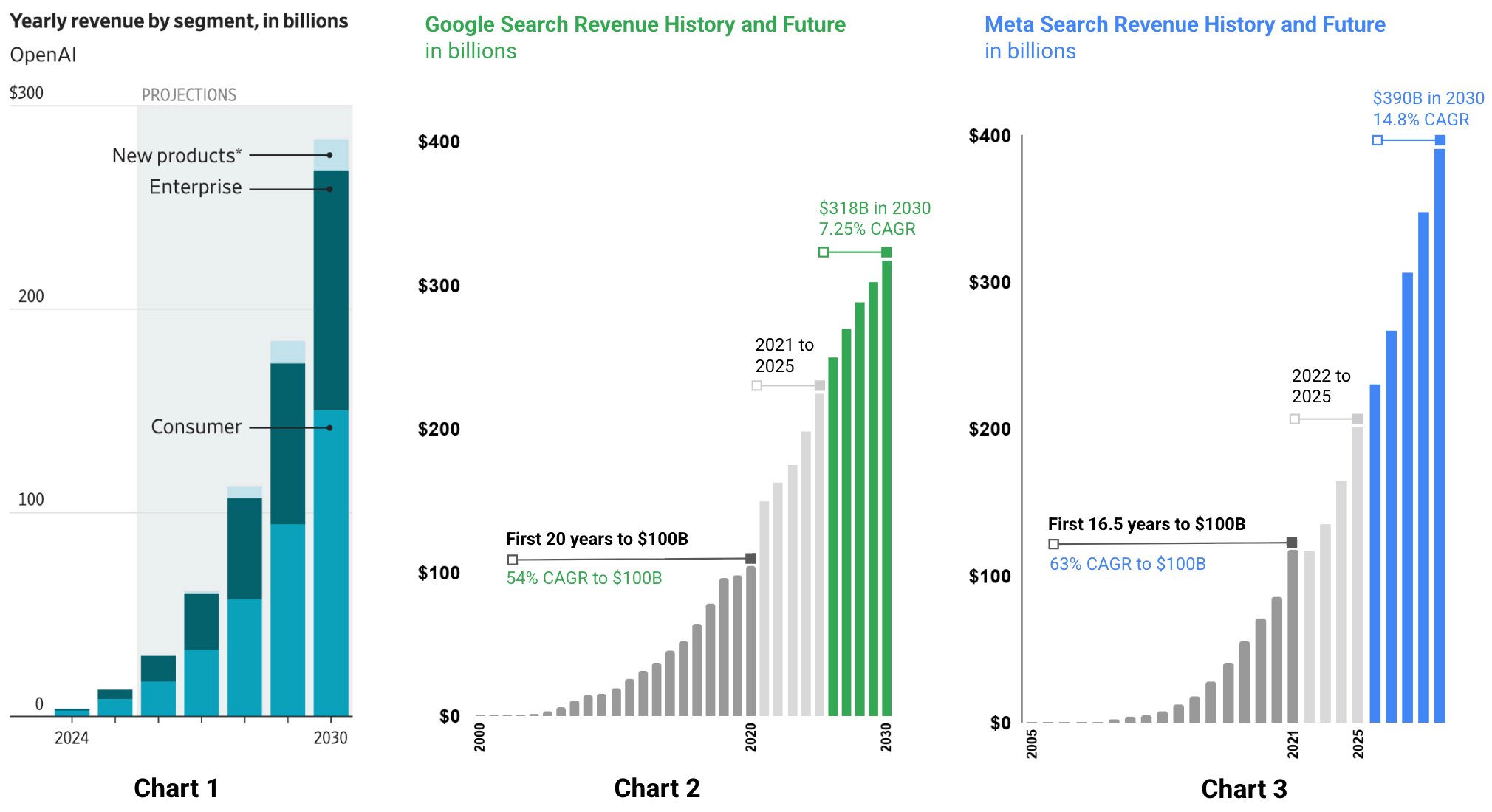
OpenAI Revenue Segments: According to the Wall Street Journal’s recent article, An Inside Look at OpenAI and Anthropic’s Finances Ahead of Their IPOs, OpenAI estimates $140 billion in 2030 “Consumer” revenue (Chart 1). Given the recent news suggesting $100 billion in 2030 “Advertising” revenue, we can infer that the company is forecasting non-advertising revenue (e.g., consumer subscription revenue) will represent 30% of consumer revenue. We believe 30% is a bit high, as only ~5% of ChatGPT’s estimated 900 million active users are paid subscribers today.
Speed of Growth: OpenAI believes ad revenue will grow from zero to $100 billion over the next five years. It took Google 20 years to reach that milestone, and it took Meta 16.5 years (Charts 2 and 3). Whereas OpenAI has the benefit of growing on top of a mature global installed base, Google and Meta grew up with the Internet (and vice versa).
CAGR Comparison: Google’s search ad revenue CAGR over its first twenty years of advertising life was 54%. Meta’s ad revenue CAGR over the first 16.5 years to $100 million was 63%. OpenAI’s CAGR will be 151% if it manages to grow from $2.5 billion in 2026 to $100 billion in 2030, which suggests its adoption curve will reach maturity in less than half the time it will take Google/Meta to reach terminal growth levels.
Terminal Growth: If we assume terminal growth rates in the advertising world are ~5% (the average expected growth rate of global ad spending), Google search will hit that level around 2032, and likely maintain the same growth rate into perpetuity as a GDP-like compounding cash flow stream well-anchored to the continued expansion of global advertising demand. Meta is younger with a different future. We expect Meta to grow at a ~14% CAGR over the next five years with $390 billion in ad revenue in 2030.
Economic Moats: We know that Google and Meta produce relatively high and consistent returns on invested capital (ROIC) of 40%+. The higher the ROIC, the faster the printing press prints cash flow. We also know that Google and Meta have generated an average operating profit margin of 30% (EBIT less adjusted cash taxes) over recent years, with little variance. We believe investors expect OpenAI to benefit from a similar economic moat.
Piecing the puzzle together
OpenAI’s investors are smart and experienced. They have access to good information and see a lot of deal flow. For them or any investor, the valuation they assign today is nothing more than the present value of expected future cash flows. If investors in OpenAI consider it as the next big thing after Google and Meta, we can use what we know to back into OpenAI’s advertising revenue. We’ll do that step by step.
Step 1: We know that the value of future cash flows is determined by the following finance formula:
For OpenAI, we know the most recent valuation is $852 billion. From what we can tell, investors are comparing future financial performance to that of Google and Meta, so we think it’s reasonable to use 40% as a plug for future ROIC at maturity.
For Cost of Capital, we think OpenAI is best compared to major ad platforms with betas around 1.2, as well as higher-beta companies in the AI space like Nvidia at 2.5. We lean more toward Nvidia and use a weighted average of 2.1.
As we mentioned above, we think a ~5% terminal rate is a reasonable enough result in the following value equation:
Step 2: Now all we have to do is rearrange it and solve for Operating Profit.
And now, with our reasonable plug values, we estimate OpenAI's Operating Profit at $88 billion at some point in the future, when it reaches maturity.
For context, Google’s operating profit in 2026 will be ~$125 billion (includes advertising, cloud, other bets, etc.) and Meta’s will be around $80 billion. If we assume 30% operating margins at maturity for OpenAI, total revenue at that future time will be $293 billion. Note that WSJ reported $280 billion in total revenue by 2030.
Step 3: Now that we have a good estimate of OpenAI’s Total Revenue at maturity, we can use the WSJ’s revenue segment input guides to arrive at a future ad revenue of ~$209 billion. The question when maturity will be reach is the billion dollar question.
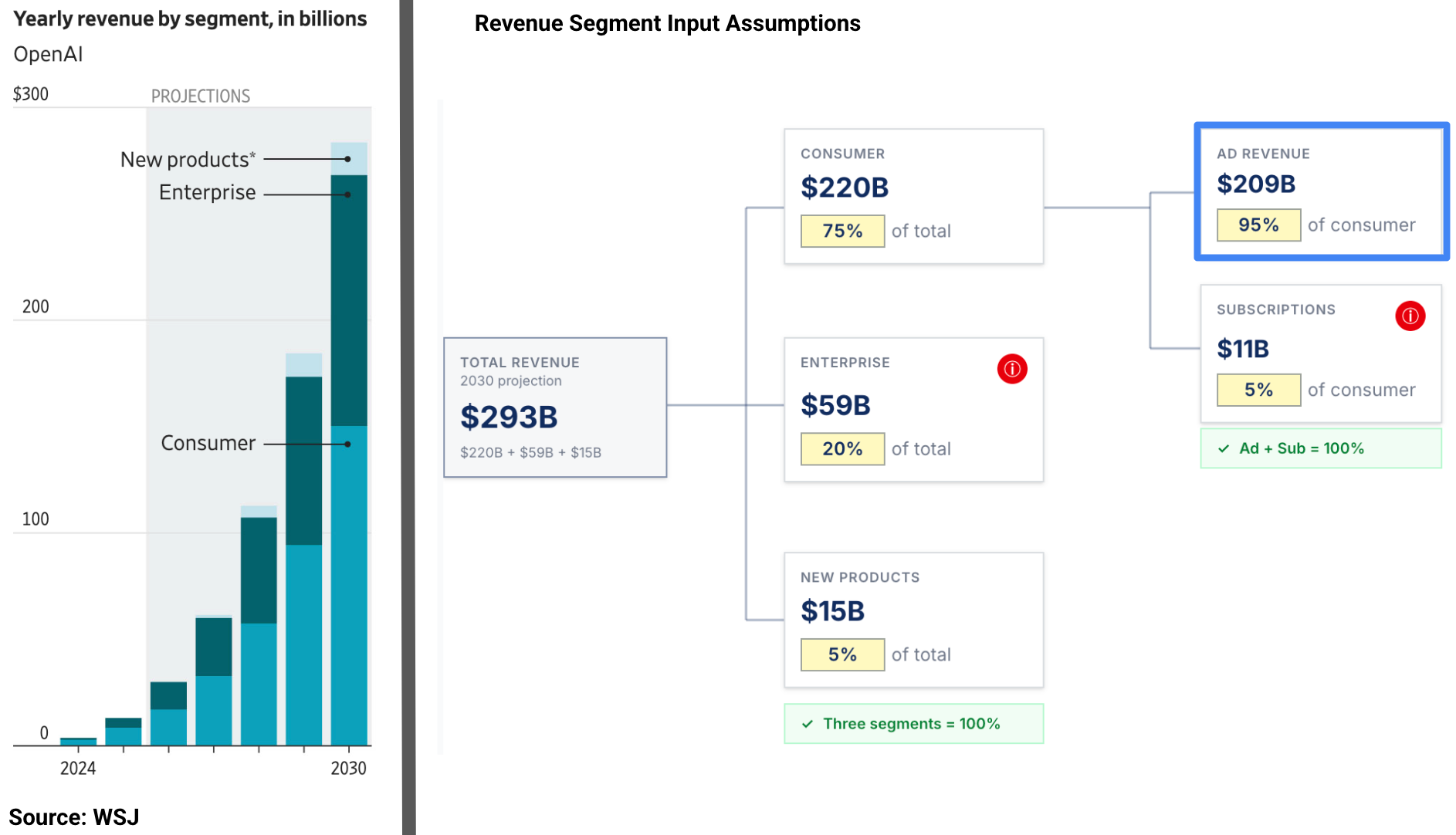
If 20% of OpenAI’s future total revenue comes from Enterprise sales (Google Cloud is 17% of total revenue), and 5% comes from what they call “New Products,” that implies 75% or $220 billion will come from “Consumer Products.”
Finally, if 5% comes from subscriptions, then investors implicitly expect OpenAI to have ~$209 billion in ad revenue at maturity.
When is maturity?
If $209 billion is the maximum number in OpenAI’s future mature state, and the stated goal is to reach $100 billion by 2030, then maturity will happen in about 10 years. The the “best-fit” diffusion curve given our current data points.
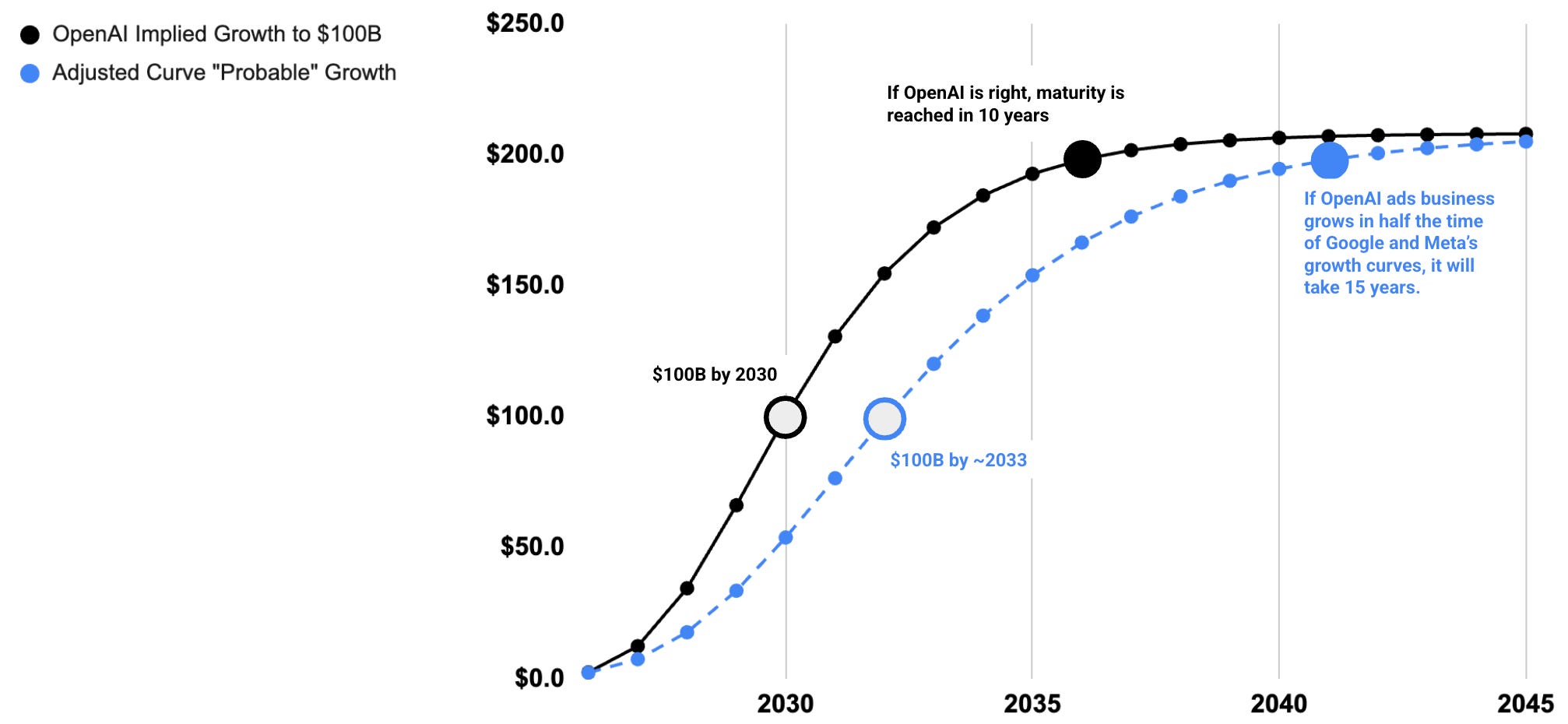
If that happens, OpenAI will have grown 3x faster than Google and Meta’s journey to maturity. At first glance, achieving advertising success so quickly might seem plausible but not probable. However, when compared with the first 10 years of growth at Google and Meta, it not only seems plausible but perhaps quite probable even though it is hard to imagine.
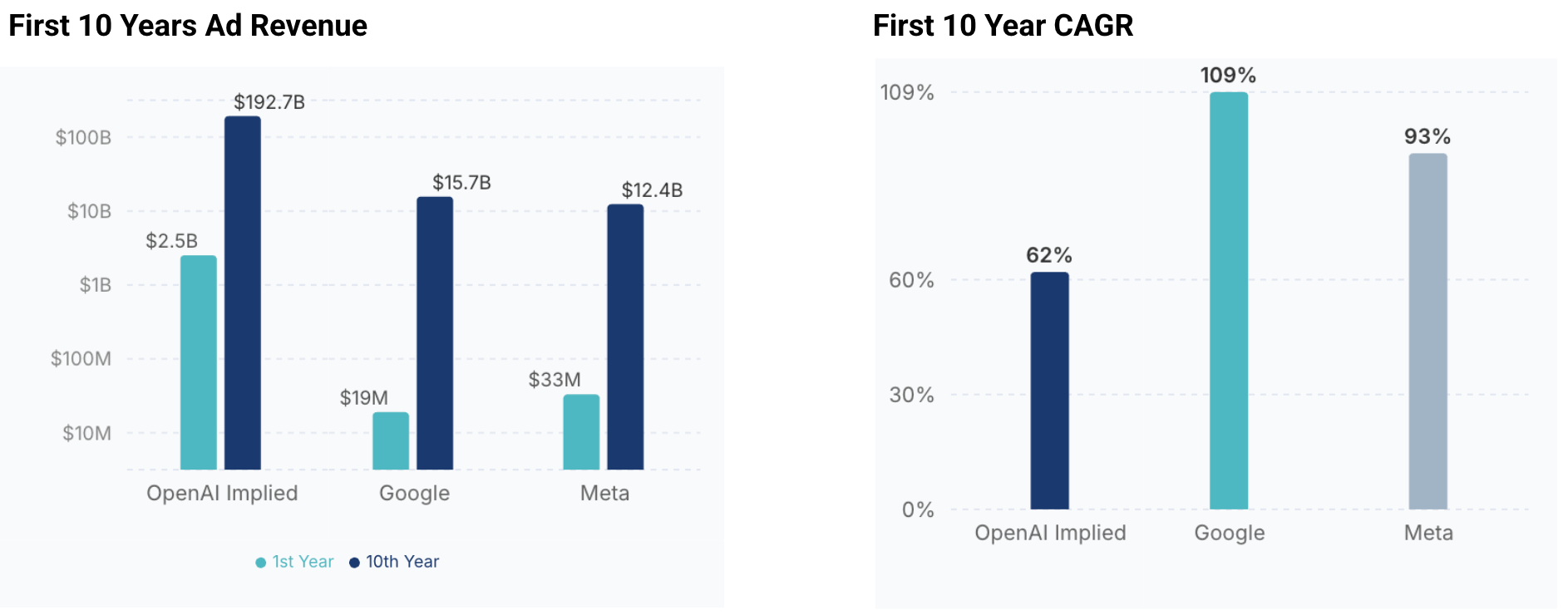
Google search experienced a 109% CAGR over its first 10 years, and Meta was similar at 93%. If OpenAI’s forecast is right and it hits $2.5 billion in ad revenue this year, and reaches maturity in ~10 years, then its CAGR will be 62%. Looking at OpenAI’s advertising future through our lens turns what is plausible and possible into likely probabality.
Try Our OpenAI Revenue Growth Estimator Tool
If you want to test your own assumptions on OpenAI’s future, then check out our Quo Vadis companion tool. The model leans on the frameworks presented in this article to estimate OpenAI’s implied advertising revenue using publicly available financial data and comparable analyses, and on your input assumptions to estimate future ad revenues at maturity. We think the S-curve slider feature is really neat! You can adjust OpenAI’s growth-curve parameters and explore your own scenarios. Enjoy!
Disclaimer: This post, and any other post from Quo Vadis, should not be considered investment advice. This content is for informational purposes only. You should not construe this information, or any other material from Quo Vadis, as investment, financial, or any other form of advice.
Thanks Debra! You’re piece is very good too!
Love the tool. I learned a lot about finance just trying to figure out what I would change about the variables.
IMHO, I don't see OpenAI getting to $100B in ad revenue in 4 years. That implies 10% of all ad spend. Just don't see it.