
Advertising Economic Forum returns to Horizon Media in New York on October 6 during Advertising Week 2026. Last year’s event was standing-room-only and widely regarded by attendees as one of the best events of the week. This year, we’re going bigger, bringing together a highly curated audience of senior industry executives, founders, investors, agencies, and adtech leaders for an afternoon focused on where value is being created next. From AI and the next generation of adtech to venture capital, M&A, CTV, the open web, audio, and the battle for advertising’s future control points. Space will be limited. Attendance is RSVP-only. Learn more at Advertising Economic Forum.
If you enjoy fall baseball, big ideas, and great conversations with smart people, you might want to join Landmark Ventures SMART Summit on Tuesday, September 22. Landmark Ventures will host an invitation-only gathering at Yankee Stadium, bringing together 150 senior executives across Sports, Media, Advertising, Retail and Technology to discuss the forces reshaping our industry, from AI and agentic workflows to commerce media, identity, measurement, audience engagement, and M&A.
Quo Vadis is bringing the conversation to the lunch table during Advertising Week New York. On October 7, we’re hosting an interactive lunch at Lafayette’s private Cave du Vin in NoHo, sponsored by pubX and in partnership with Nadia Gonzalez. We’re curating a room of senior executives, founders, investors, and industry leaders for great food, smart conversation, and the kind of relationship-building that’s hard to find during a packed week like AWNYC. pubX will share a major company milestone and the launch of its groundbreaking agent-to-agent advertising capabilities, with a live campaign activation. Space is limited. Attendance is RSVP-only.
What Founders Really Build (Coordination)
In our first essay in this series, Where Media Money Wants to Go (The Market), we said:
“Capital continuously seeks higher expected utility.”
In our second essay today, we ask:
If capital seeks higher utility, who creates that utility?
Answer: The CEO Founder does.
A founder’s job is not to build products
Many times every day, every CEO Founder is asked a version of the same question. “What does your company do?”
Sadly, in too many cases, the answers coming back are remarkably consistent.
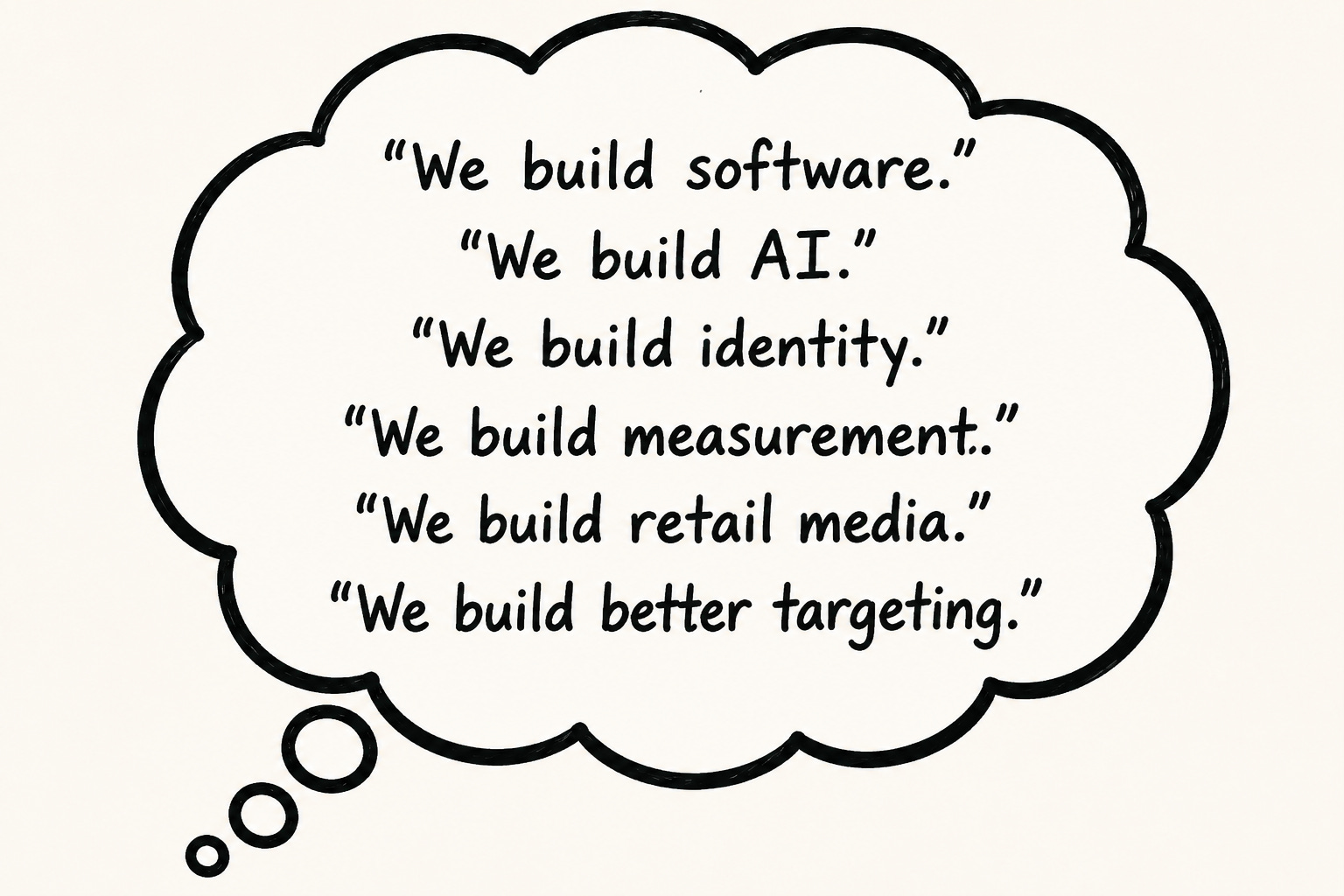
The problem with these undifferentiated answers is that they only describe the product and completely fail to describe the CEO Founder’s actual job.
Products are really just one of the tools founders use to create value. The real job is about coordination, and the mechanism for coordination is deal-making. For instance, customers must be convinced to buy, employees must agree to build and sell, investors must get comfortable financing the business amid alternatives on a constantly shifting risk-reward continuum, partners must agree to integrate, suppliers must agree to deliver, and so on. Deals, deals, deals… everywhere making deals!
The best CEO Founders are deal-making machines aiming for a common objective that ultimately does what every business needs to do: sell the product.
Comparative advantage and returns to specialization
Importantly, there is a sound economic reason that explains why dealmaking sits at the center of the founder’s job. Economies work because of two key concepts called comparative advantage and the returns to specialization. That’s a fancy way of saying:
I do what I do best, you do what you do best, we trade, and we’re both better off.
We know that specialization can create enormous value, but it also creates interdependence. Someone has to put all those specialized pieces back together. (e.g., engineers build, salespeople sell, investors provide capital, and suppliers provide inputs, etc.)
Enter the Founder CEO and his/her job-to-be-done, whose primary job is to get deals done. We recommend thinking about a “deal” as an agreement between specialized parties to cooperate because each expects to be better off afterward. For example, customer contracts, employment agreements, raising capital, partnerships, supplier relationships, and acquisitions are all deals to be done.
It is the CEO Founder who sits at the center of these exchanges, aligning incentives to produce a collectively valuable outcome.
From that lens, every successful company is really a network of voluntary agreements held together by leadership and vision. That might sound obvious, but it’s worth thinking about because coordination is surprisingly difficult when markets are filled with people pursuing different incentives and different alternatives at different speeds.
This coordination skill is one of the reasons venture capitalists often say they invest in founders as much as ideas. Importantly, Marc Andreessen observed that when a great founder meets a lousy market, the market will win in a soul-crushing way. And when a lousy team meets a great market, the market wins again and deservedly so. It’s only when a great team with a highly coordinated CEO Founder meets a great market that something exceptional happens.
So, when a massive, high-growth market creates an opportunity, it is the CEO Founder’s number-one job to determine whether his/her organization can coordinate well enough and fast enough to capture it. Coordination and deal-making skills make all the difference.
This distinction becomes even more important in advertising technology because founders often misunderstand who they’re competing against. For example, DSPs think they compete with other DSPs while SSPs believe they compete with other SSPs, and identity companies in the middle are convinced they compete with other identity companies… and so on.
Sure, that perspective is true at one level, but it misses the larger picture. But the real competition is the alternatives that make it easier for marketers to allocate capital. For instance, Google, Meta and Amazon don’t win because they have the best product in every category. They win by coordinating incentives into a system that feels effortless to the buyer. And as we argued in the first essay, capital seeks the path of least resistance. Therefore, the better the coordination, the easier it becomes for marketers to put their next dollar to work. Some folks call this the “easy button,” but it is the coordination skill and effort that make it true.
Imagine two companies, A and B, start from the exact same place and end up in very different places. Company A and Company B each raise $5 million at a $20 million pre-money valuation to build similar agentic CTV marketplaces. Both need customers, publishers, employees, suppliers, and partners. Think of each of these counterparties as a node and every agreement connecting them to the company as a deal.
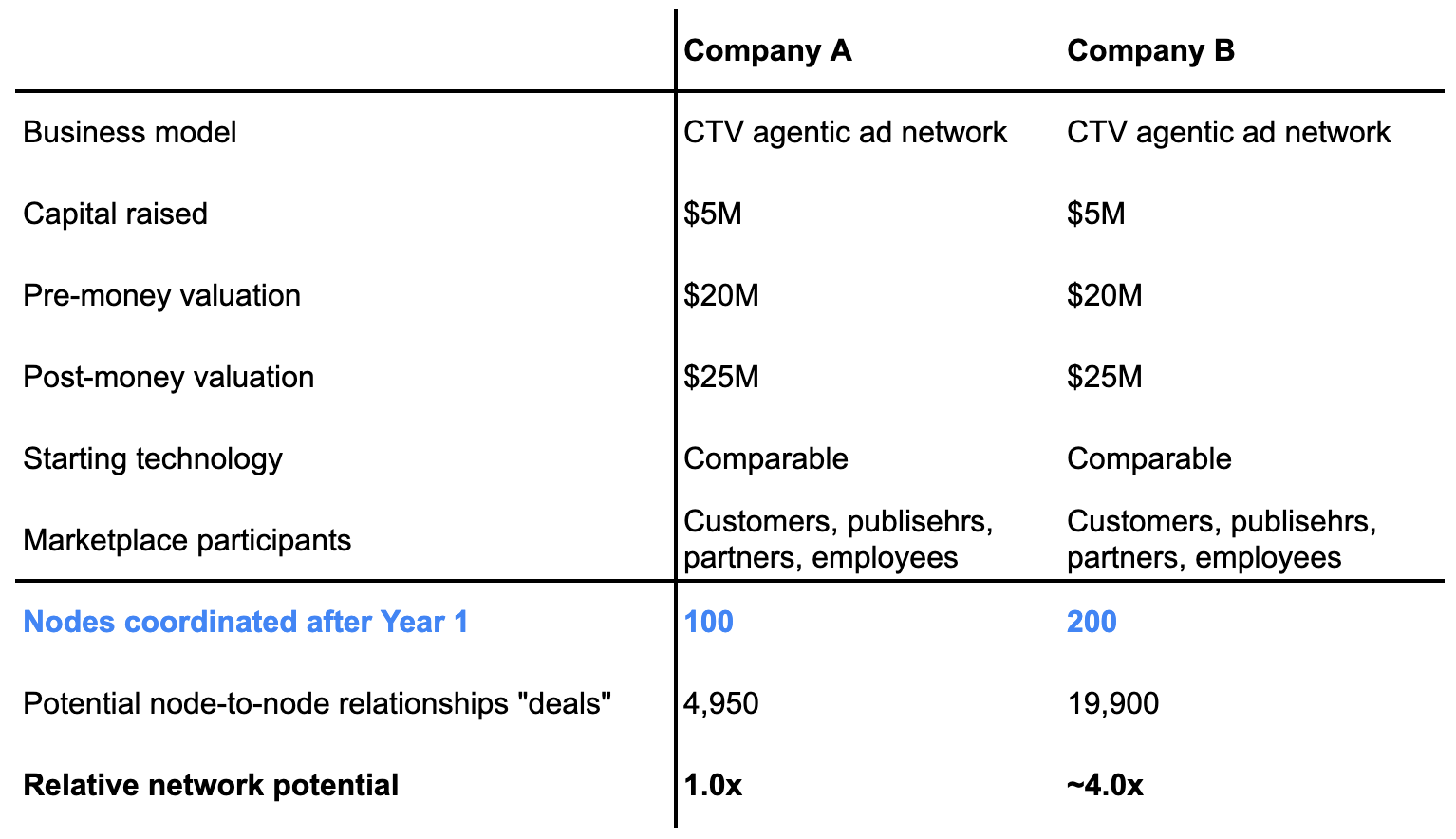
Company A coordinates 100 nodes during its first year, while Company B coordinates 200. At face value, Company B has built twice as many relationships. However, from the lens of network effects and using Metcalfe’s Law as a mental model, 100 nodes represent 4,950 connections (“deals”), while 200 represent 19,900. That’s roughly four times the “deal” connectivity.
Sure, not every connection has equal value, but the principle that matters most here is that great CEO Founders not only make more deals, but they also make deals that increase the value of the deals they’ve already made. That’s how coordination multiplies exponentially into network effects and, ultimately, the enterprise value all stakeholders are looking to capture.
Food for Thought
From what we can observe, too many adtech founders often describe their companies in terms of features. However, customers (advertisers, agencies, and publishers) experience these companies through outcomes. It’s a real Venus vs. Mars scenario, and the more it goes unrecognized, the greater the probability of falling into Geoffrey Moore’s chasm.
Between the product and the process of delivering desired/repeatable outcomes lies enormous coordination and orchestration. Consider something as seemingly straightforward as launching a new product feature. Engineering has to build it, marketing has to position it, sales has to talk about features and sell benefits, customer success has to support it, finance has to fund it, and most importantly, the customer has to adopt it without adding unnecessary complexity or friction.
That last part matters enormously in advertising, where marketers at brands and agencies increasingly expect solutions to be easy to use, fast to implement, effective, and relatively inexpensive. Delivering all of those things at once requires tremendous coordination because, as the old adage goes:
“You can have it fast, good and cheap, but you can only pick two.”
AI in adtech makes this distinction even sharper. Yes, AI can increasingly write software, generate media plans and creative assets, summarize meetings, automate workflows, and increasingly execute the buy-sell trade. But what it cannot do is replace the CEO Founder’s role as the chief coordinator of human incentives.
More importantly, what AI is clearly doing is increasing the value of coordination because it lowers the cost of creating features/products while raising the importance of deciding which features/ products should exist, which partnerships matter most, and where organizational attention should be directed.
Taking notice
Have you ever noticed how founders who create the most value appear to spend so little time talking about their actual products? This particular 99th percentile cohort spends time understanding customers, recruiting exceptional people, forming strategic partnerships, raising capital, and negotiating acquisitions (increasingly so in the current cycle).
They are orchestration maestros. The best part is that they were not born with this skill, but they understand it completely and just do it. And that’s exactly what creates a winning culture where everyone already knows what to do when the boss is not around.
Looking from the outside inward, the irony is that it can look like these coordinating CEO Founders are distracted from building the business. But in reality, that is the business.
CEO Founder Case and Point: Brian “ BOK” O’Kelley
Long before being called the “Godfather of Programmatic,” BOK helped build Right Media and later founded AppNexus. On the surface, these were advertising technology businesses operating across the DSP and SSP ecosystem, but another way to understand what BOK was really building, then and again today, is coordination.
Before programmatic advertising became an established market, it was a shiny new object promising to change how advertising was bought and sold. Making that promise real required skeptical advertisers, fearful agencies, threatened publishers, emerging exchanges and incomplete data providers. All of these participants were pursuing different incentives and looking to trust one another enough to transact at an enormous scale. The technology created the capability, but it was the purposeful coordination that created the market around it.
Fast-forward to today, and BOK is essentially tackling the same problem again in the agentic era. Efforts such as AdCP and AgenticAdvertising.org aim to coordinate buyers, sellers, agents, and technology providers around common ways of interacting. Just like in the past cycle as individual pieces of adtech become increasingly commoditized, the larger opportunity lies in organizing all the components into a coordinated system that creates more value than the pieces can on their own.
As we’ll see in the next essay, something remarkable happens when a unit of coordination expands beyond a single company.
Previous Essays in this series
#157: Where Media Money Wants to Go (Market)
Disclaimer: This post, and any other post from Quo Vadis, should not be considered investment advice. This content is for informational purposes only. You should not construe this information, or any other material from Quo Vadis, as investment, financial, or any other form of advice.