
Earlier this week, I sat down with Mathieu Roche for an impromptu Quo Vadis webinar interview to unpack Publicis’s acquisition of LiveRamp, one of the most consequential transactions in adtech. The basis for our discussion was our Quo Vadis post, Publicis bought LiveRamp for a seat at the Identity Trade-Off Frontier.
If you would like to connect with Mathieu in Cannes, NYC, or in Europe, reach out to him here: mroche@id5.io.
What started as a discussion about a single M&A deal evolved into a broader conversation about the future economics of identity, data collaboration, and who ultimately captures value in the advertising ecosystem.
At first glance, the financial rationale for the deal appears incomplete. LiveRamp has built a meaningful business with strong market share, but it has historically generated economic returns well below those of Publicis and below its own cost of capital. Publicis, by contrast, has become one of the highest-performing agency holding companies in the world, generating exceptional returns on invested capital.
If this acquisition were simply about improving margins or extracting cost synergies, it would be difficult to justify the strategic significance of the move. Instead, the more compelling explanation is that Publicis was buying position rather than profits, vis-à-vis acquiring infrastructure, relationships, and the ability to shape how data moves through the advertising ecosystem.
Landowners, Farmers, Infrastructure: This led us to an analogy that increasingly resonates with the industry’s evolution. Historically, agencies have been farmers. They rented access to media, technology, and data owned by others, attempting to create value through expertise and execution, but the underlying assets belonged to someone else.
Over time, however, those who owned the platforms, data, and infrastructure increasingly captured a larger share of the economic value. Publicis appears to be pursuing that very same model in a hybrid form. Through acquisitions such as Epsilon, Lotame, and now LiveRamp, it is transforming itself from a renter into an infrastructure owner, to and from the land assets that can be leveraged repeatedly across thousands of clients rather than relying solely on labor-intensive services. As Mathieu observed during our conversation,
“You build it once or buy it once and then sell it multiple times. That’s how you create leverage.”
Check out our post titled "The Two Landowners of Adwell Hollow" for a deeper perspective.
Identity Trade-Off Frontier: The discussion then turned to what we have previously described as the Identity Trade-Off Frontier. For years, marketers faced a familiar constraint:
Improving data/ID precision often meant sacrificing scale, while increasing scale came at the expense of data/ID accuracy.
Yet over the past decade, advances in identity infrastructure have steadily pushed this frontier outward. Advertisers can increasingly achieve both broader reach and greater confidence in audience recognition.
However, Mathieu highlighted an important distinction that is often overlooked.
Identity quality and audience quality are not the same thing. Identity answers the question, “Am I confident this person is who I think they are?” Audience quality asks, “Is this the right person to target?” Identity is the connective tissue that enables activation and data determines whether the resulting decision is valuable.
That distinction led to perhaps the most important insight from our conversation. As Mathieu framed it, identity is the means of exchange. It enables transactions, but it is not the transaction itself.
Identity itself is not the asset being traded. Rather, identity functions as the currency that enables trade. The assets being exchanged are media inventory, audience data, and measurement signals. Identity provides the common language that allows buyers and sellers to transact with confidence. Without it, data cannot be activated, inventory cannot be valued appropriately, and collaboration becomes difficult.
Once viewed through that lens, the network effects become easier to understand because the value of an identity framework increases with each additional participant. A single publisher adopting an identifier creates limited utility.
For instance, two participants create the possibility of a transaction, but thousands create a flywheel marketplace where publishers adopt because buyers support the identifier, and buyers adopt because publishers make inventory available, and then data providers participate because both sides have assembled. In essence, every new participant increases the value of participation for everyone else.
Importantly, the hardest participant to recruit is often the first one. Each subsequent participant lowers the friction required to attract the next.
Gravity Theory of Data Trade: This dynamic led to a discussion of what I have called the Gravity Theory of Data Trade. Borrowing from international economics, trade between nations tends to be driven by two primary variables: the size of the economies involved and their proximity to one another. A similar principle may increasingly apply to advertising, where the largest participants with the strongest connections generate the greatest volume of trading collaboration.
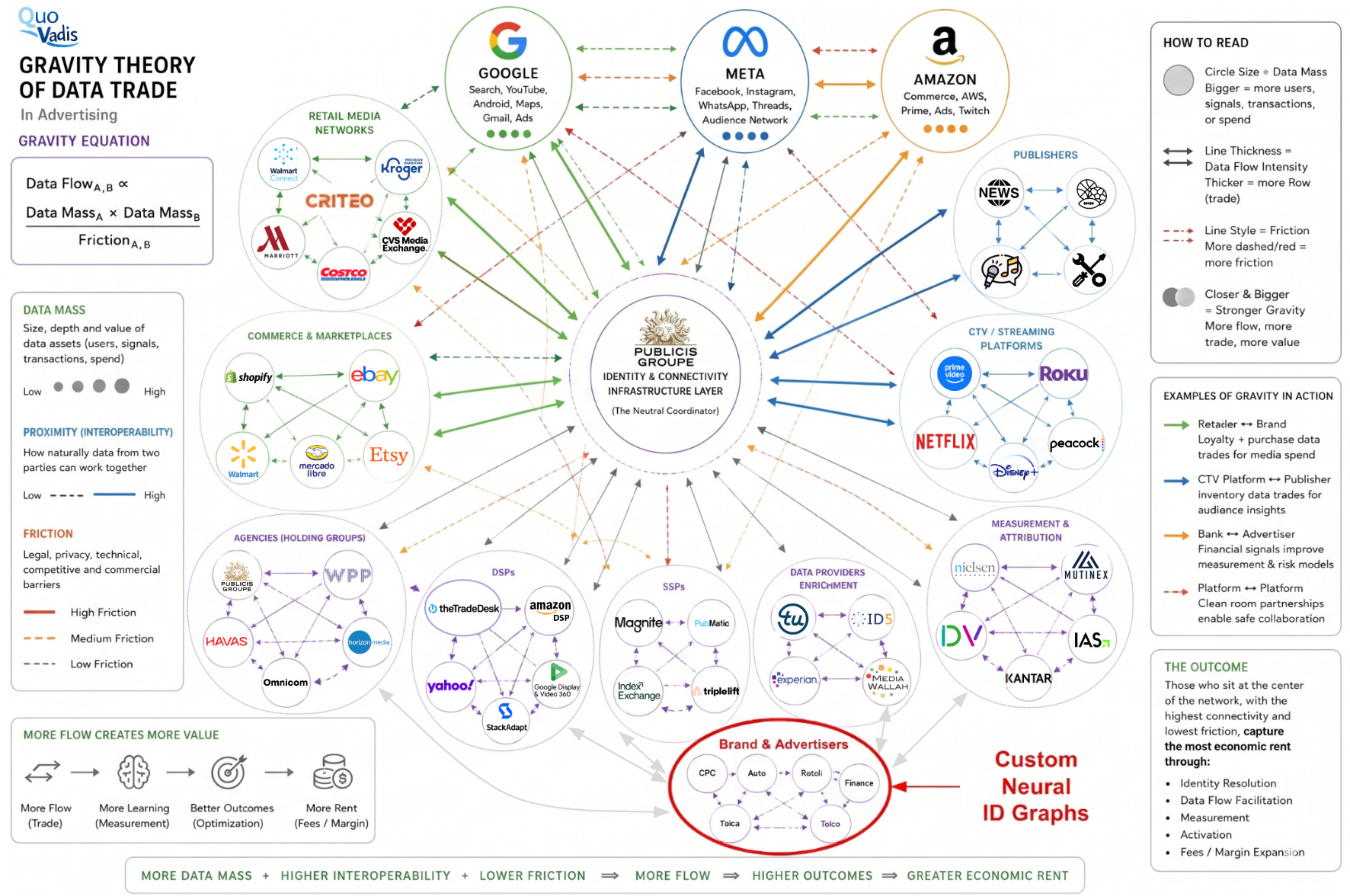
Viewed this way, identity infrastructure is not merely a targeting tool. It becomes the marketplace infrastructure that enables the flow of inventory, data, and measurement across the ecosystem.
The strategic question shifts from “Who owns the best identity graph?” to “Who sits at the center of the largest and most efficient network of data exchange with the ‘currency’ to fascilate trades?”
Neutrality: Of course, no discussion of the Publicis-LiveRamp transaction would be complete without addressing neutrality. Prior to the acquisition, LiveRamp operated as an independent intermediary serving a broad range of participants. Now it sits within one of the world’s largest agency holding companies.
That ownership inevitably introduces friction.
Will competing agencies continue to rely on the platform?
Will brands worry about becoming locked into a particular ecosystem?
Will data partners continue to participate at the same rate?
All of those questions notwithstanding, Publicis undoubtedly modeled these risks before making its bid, hedging on the assumption that if enough of the network remains intact, the strategic advantages would still prove substantial. As Mathieu pointed out:
Publicis now controls a network that competitors may have to rebuild themselves if they choose not to participate.
Whether Publicis’ rationale for acquiring LiveRamp ultimately proves right remains to be seen. What is already clear, however, is that this acquisition has changed the conversation around identity, which is great for the ad industry.
The industry is now moving beyond debates about cookies and identifiers alone and leaning hard/fast into the next phase defined by infrastructure, collaboration, network effects, and the economics of trust.
The winners may not simply be those who own the most data. They may instead be those who build the systems that allow everyone else to put that data to work. That possibility is what makes this moment so fascinating.
Extra Education: Early this week, Mathieu posted a five-minute masterclass about data and identity on LinkedIn. Check it out here.
#CannesLions is around the corner! One thing is for sure… the Publicis-LiveRamp deal is going to make Cannes even more interesting than usual. Looking forward to seeing you at these events.
Commerce Media: See this series of Fluent events. Sir Martin Sorrell and I will have a chat and open it up to Q&A.
Agency Agentic Flows: 50-person RSVP breakfast with AtomicAds, the winner of the AdEF founder pitch event in March
Signal owners, platform leaders, and operators are rebuilding the layer underneath advertising. 50-person RSVP breakfast with Brian O’Kelley and Gabriel DeWitt, hosted by Above Data.
Criteo Lunch Panel: Measurement Models and Redefining Efficiency with Brian Wieser, Todd Parsons, and Tom Triscari
Buyer/Seller Agents: 25-person RSVP lunch with pubX
The Transparency Paradox Debate on Mediaocean’s yacht. Bob Lord and Brian Wieser debate transparency vs. performance, moderated by Bill Wise and yours truly
PMG Beach: How to Survive in a Post-LiveRamp World at PMG Beach: Sam Bloom, Mathieu Roche from ID5, and yours truly tell it like it is.
Criteo Yacht Talk: Wired Different. B.R.O.s at Work
C Wire AdTech Chill House: 1-1 chat with Sir Martin + Audience Q&A. We’ll end the week talking about what happened and why it matters.
Disclaimer: This post, and any other post from Quo Vadis, should not be considered investment advice. This content is for informational purposes only. You should not construe this information, or any other material from Quo Vadis, as investment, financial, or any other form of advice.


