
Advertising Economic Forum is back during Advertising Week New York. On October 6, 2026, AdEF returns to Horizon Media’s NYC headquarters for an afternoon focused on where value is being created next across advertising, media, technology, AI, venture capital and M&A. Last year, 200+ industry leaders packed the room. We’re bringing a serious, intellectually curious vibe back this year, with an even stronger program built around the people funding, building and acquiring the next generation of advertising technology. If you’re in NYC for Advertising Week, AdEF is the room to be in. Check out the event site, speakers and agenda.
If you enjoy fall baseball, big ideas, and great conversations with smart people, you might want to join Landmark Ventures SMART Summit on Tuesday, September 22. Landmark Ventures will host an invitation-only gathering at Yankee Stadium, bringing together 150 senior executives across Sports, Media, Advertising, Retail and Technology to discuss the forces reshaping our industry, from AI and agentic workflows to commerce media, identity, measurement, audience engagement, and M&A.
2Q26 Portfolio Update
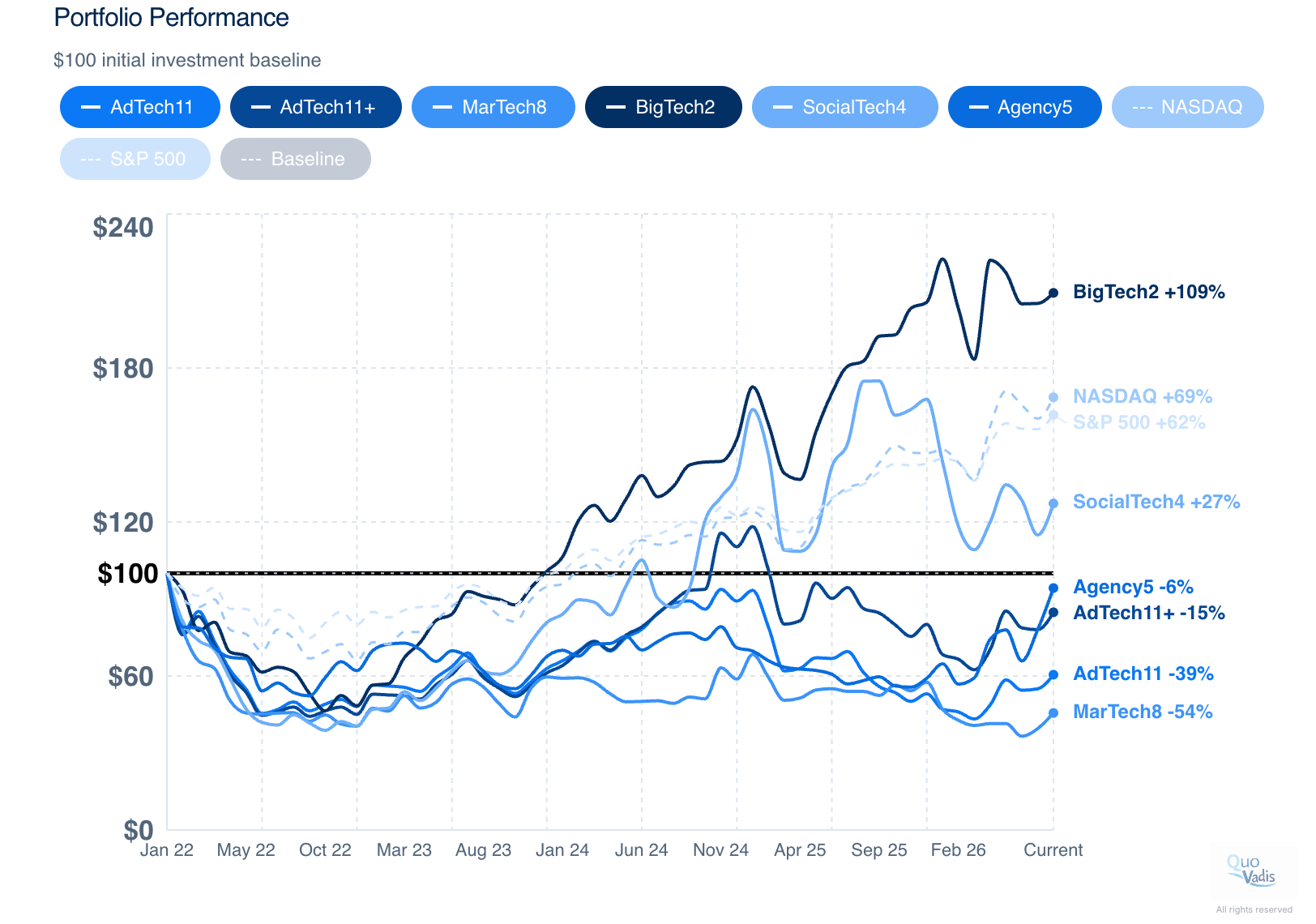
With 2Q 2026 earnings now (nearly all) reported and the market’s verdict in, we can assess how our equal-dollar portfolios have performed since our 1Q26 update in early June.
As a reminder, each portfolio starts with a $100 investment in January 2022, divided equally across all constituent stocks. We rebalance on an equal-dollar basis whenever a constituent exits public life (IAS, RAMP, and now a growing list) or when a relevant company goes public, like Mountain last year (how long will public life last) and LiftOff in June.
Benchmarks
Since January 2022, the NASDAQ and S&P 500 are up ↑69% and ↑62%, respectively.
BigTech2
No surprise here, but our two BigTech ad players (Google and Meta) keep compounding. Had you invested $100 on a 50/50 basis in January 2022, you’d be ↑109%. GOOG is up +144%, and META is up +75%.
The moat gold standard of the advertising world remains intact by owning the best land (data), which the farmers (advertisers) keep paying rent in the form of capital allocation. As we pointed out last week in an essay titled Where Media Money Wants to Go, advertising is not a marketplace for media; it is really just a marketplace for capital allocation.
Marketers increasingly choose platforms like Google and Meta (and Amazon too) even when those platforms don’t provide visibility into how every advertising dollar is spent. Budgets continue to migrate toward products such as Google Performance Max, Meta Advantage+, Amazon’s AI-powered advertising solutions and agency principal-based trading because marketers entrust them with their capital.
AdTech11
Our AdTech11 portfolio is down ↓39% since inception, which is a fair improvement from ↓45% in our 1Q update. But the bigger story this quarter isn’t about performance, it’s more about disappearance from public life.
ZETA↑208% (still public): Now the biggest market cap in our AdTech11
MGNI↑39% (public): A nice Q2 beat, stock jumped ~18%
DSP (Viant) ↑32% (public): The stock has held up year-to-date, but with a market cap flirting just below $1 billion, it would not be surprising to see it exit public life. It would also not be surprising for the Vanderhook brothers to take advantage of the current buyer’s market from an M&A perspective.
RAMP↓26% (exited): Acquired by Publicis for $2.2 billion. There was lots of pre-Cannes fanfare about knock-on M&A across the identity space, but that has not materialized (yet).
DV↓60% (exiting): Nielsen offered $2.15B in an all-cash deal last week. With its only peer (IAS) leaving public life last year, DV’s exit should not be a surprise. FWIW, we like the Nielsen-DV tie-up.
TBLA↓46% (public): The Realize strategy is starting to make more sense, but the market remains skeptical. At this valuation, Taboola increasingly looks like either a value story that needs to prove itself or another reasonably digestible AdTech acquisition (e.g., by Yahoo).
PUBM↓47% (public): Still a solid independent AdTech company trapped in a very small public-market wrapper. With a sub-$1 billion market cap, improving fundamentals, and strategic supply-side infrastructure, PubMatic increasingly looks more valuable to a private buyer than to public-market investors.
CRTO↓53% (Likely exiting) — Vista Equity is looking to take it private at a ~30% premium. So much potential, but a consensus-driven (vs. consultant-and-decide) management culture, with way too many people in private equity, is just what the patient needs to become a better version of itself.
TTD↓85% (public, for now) — The downward performance slide continued in 2Q with revenue growth slowing to 3%. We think the market has overreacted, taking the market cap down to ~$6 billion. Revenue growth can be corrected to the 10% range, and with current NOPAT margins at 20% and ROIC above 30%, the company’s free cash flows are worth significantly more.
TEAD↓95% (public, barely): With a ~$70M market cap and a heavy debt load, the equity is pricing in serious distress. The underlying assets still have strategic value, but at this point the question is less about public-market recovery and more about who will ultimately own the assets and what happens to the capital structure along the way.
MNTN (public): Added after IPO in June 2025. The newest public performance-CTV story has had a rough introduction to public markets. Its differentiated position at the intersection of CTV and performance makes it strategically interesting, particularly if the valuation stays compressed.
AdTech11+
Including the flywheel known as AppLovin, the portfolio sits at ↓15%. APP is still up ↑267% since January 2022, but the flywheel wobbled a little this quarter with a Q2 revenue miss sending the stock down ~20%. Even though landowners like AppLovin can hit a drought season once in a while, we still like the company’s flywheel position, with tremendous growth prospects in new areas like CTV and the open web as that sector continues to evolve into web app utilities.
MarTech8
Still deeply in the red at ↓54% (SHOP, HUBS, SPT, SEMR, TWLO, BRZE, YEXT, AMPL). The AI-disrupts-SaaS discount has not lifted, and we don’t think the toothpaste can be put back in the tube. Since venture-backed companies are essentially outsourced innovation, the good news for our SaaS group is that AI may dramatically compress the startup-to-exit cycle. Rather than the traditional 8–10 year journey from founding to liquidity, we expect many of the most useful AI companies to be acquired within 2–3 years. Incumbent SaaS companies may find it faster, cheaper, and less risky to buy proven AI innovation than build it themselves and apply the new tech to a large customer base.
SocialTech4
↑27% (META, SNAP, PINS, RDDT), but the positive performance masks extraordinary dispersion with Reddit +221% and Meta +75% driving the portfolio, while Pinterest −35% and Snap −89% have both destroyed substantial value.
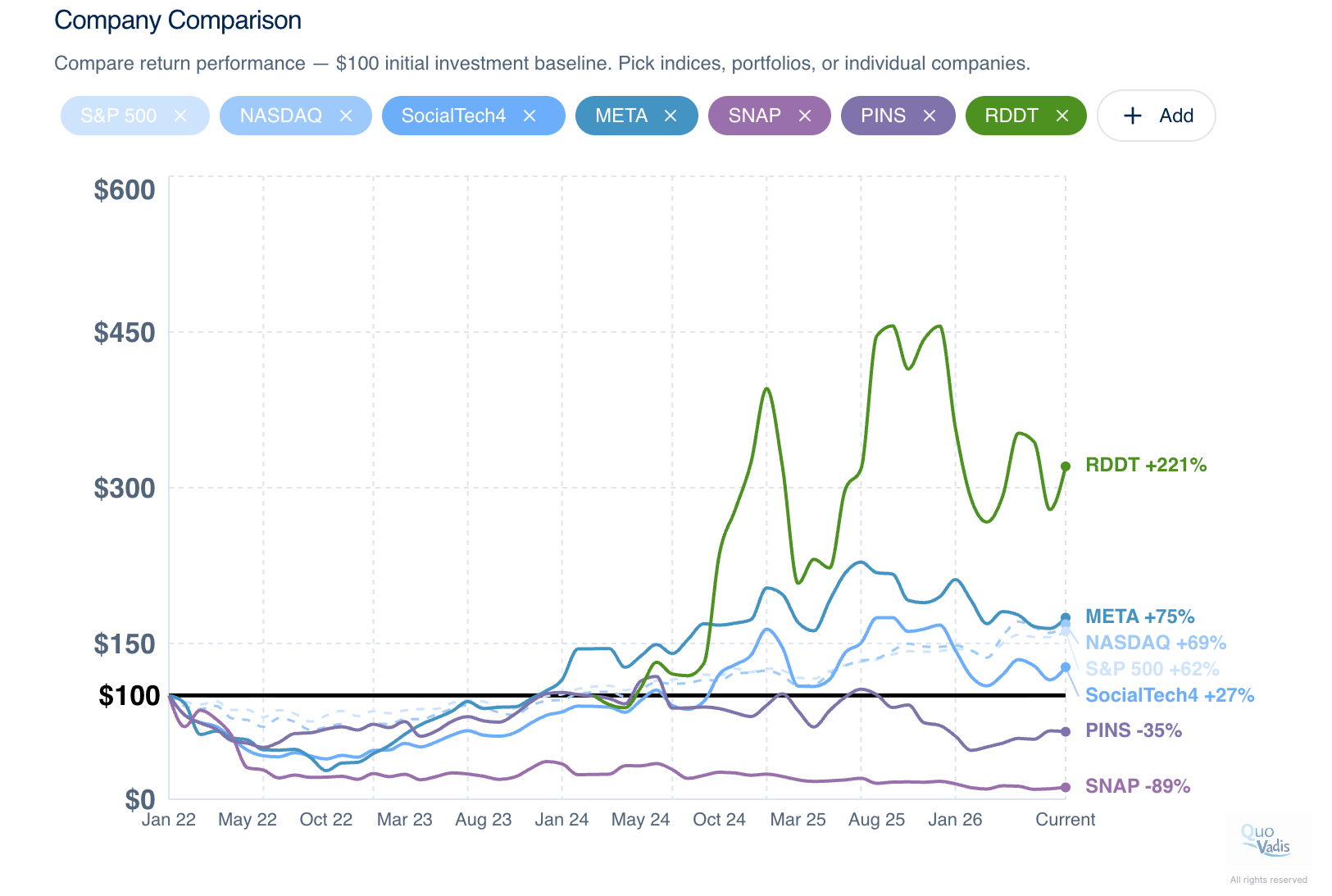
Meta is a quality cash flow machine through and through. It has no weak spots as far as we can tell.
Reddit is an asymmetric winner demonstrating what happens when a previously under-monetized consumer asset closes the monetization gap as advertising, data licensing/search, and AI-related utility become more valuable.
Snap’s performance funk suggests the market has substantially impaired its view of Snap’s long-term economics.
Pinterest seems stuck between consumer scale and commercial intent, but the −35% return suggests investors still don’t see sufficient monetization/product execution to translate that utility into superior economic returns. If the SMB CTV opportunity materializes with its TVScientific acquisition, then we might see some upside over the next few quarters.
Agency5
↓6%, with Publicis (PUBGY, ↑71%) doing nearly all the heavy lifting. But the underlying picture is improving as every major agency appears to have passed the bottom of its U-shaped valuation curve.
Omnicom and Stagwell are back above our $100 starting point, WPP has bounced sharply from its lows, and S4 Capital has stopped falling. The question now is whether this is the beginning of a sector rerating or simply stabilization after several years of brutal multiple compression.
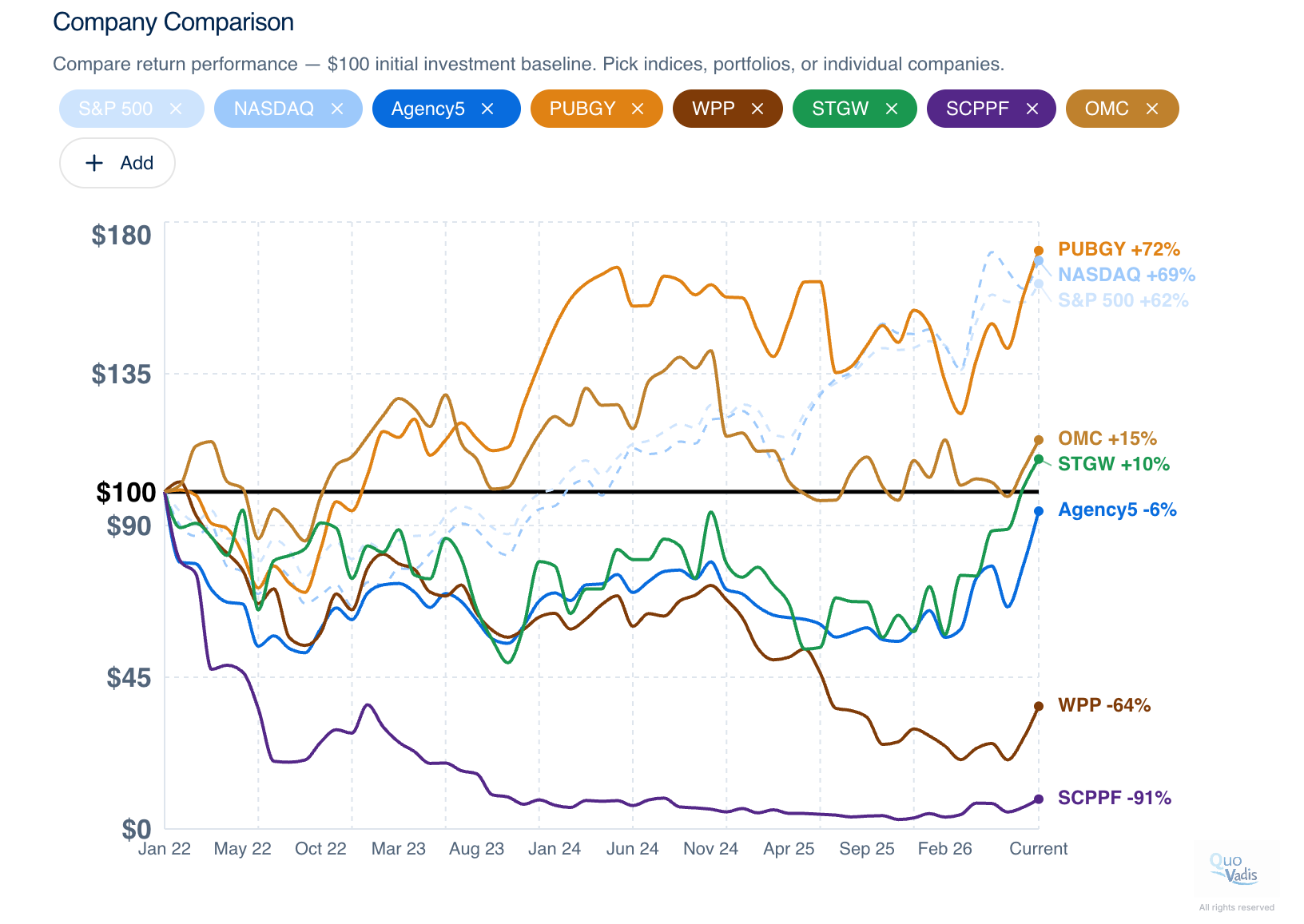
Perhaps the most important change across the agency scene is not that the agencies are performing well, but that they have stopped performing worse (with the exception of Publicis). The next leg depends on whether AI, meaningful increases in revenue/employee, smart acquisition, consolidation, and operating leverage can turn stabilization into actual growth.
The Great Consolidation Continues
Public markets are effectively telling sub-scale AdTech companies:
Grow into your valuation, consolidate with each other, or sell to someone who can extract more utility from the assets.
In our 1Q update, we wrote about Publicis buying LiveRamp for a seat at the Identity/Data Trade-Off Frontier. A quarter later, the consolidation theme has gone from a trend toward a slow stampede. Look at the AdTech11 exit list:
IAS → Novacap ($1.9B take-private, closed December 2025)
LiveRamp → Publicis ($2.2B deal)
Criteo → Vista Equity-backed take-private (July 2026, ~30% premium)
DoubleVerify → Nielsen ($2.15B all-cash, August 2026)
A meaningful portion of our tracking portfolio has already left public life. Both verification players are now private, and the market-share-leader identity layer is inside a holding company while the largest independent commerce-media platform is going to private equity at a ~30% premium, which is half of its 2021 valuation.
The message from the market is consistent with what we wrote in The Two Landowners of Adwell Hollow. With Google and Meta controlling ~45% of all ad spend, sub-scale public AdTech “infrastructure” companies find it increasingly difficult to earn attractive public-market multiples. Their ability to generate durable cash flow has simply not measured up to the earnings narratives that accompanied their public listings. Eventually, the valuation gap becomes too large to ignore. And here we are today, with reality setting in, as strategics and private equity step in to buy these businesses at premiums that investors and boards increasingly cannot refuse.
There is also a scale problem hiding underneath the valuation problem. Being a $500 million or $1 billion public AdTech company comes with all the costs and scrutiny of being public, without necessarily having the market power, growth, liquidity, or strategic optionality required to earn a premium multiple. In many cases, these assets may be worth more within something larger than they are on their own.
Importantly, consolidation can become self-reinforcing. As Criteo, LiveRamp, IAS, and DoubleVerify disappear from public markets, the remaining independent assets become scarcer and increasingly obvious acquisition targets. As it turns out, our Quo Vadis AdTech11 may ultimately prove less useful as a permanent stock index than as a waiting room for consolidation.
Who’s Next? Ranking the Remaining AdTech11 by a 12-Month Takeout Probability
With most of the remaining names below (or near) $1B in market cap, we took a crack at rank-ordering the survivors by a subjective probability of being acquired in the next 12 months.
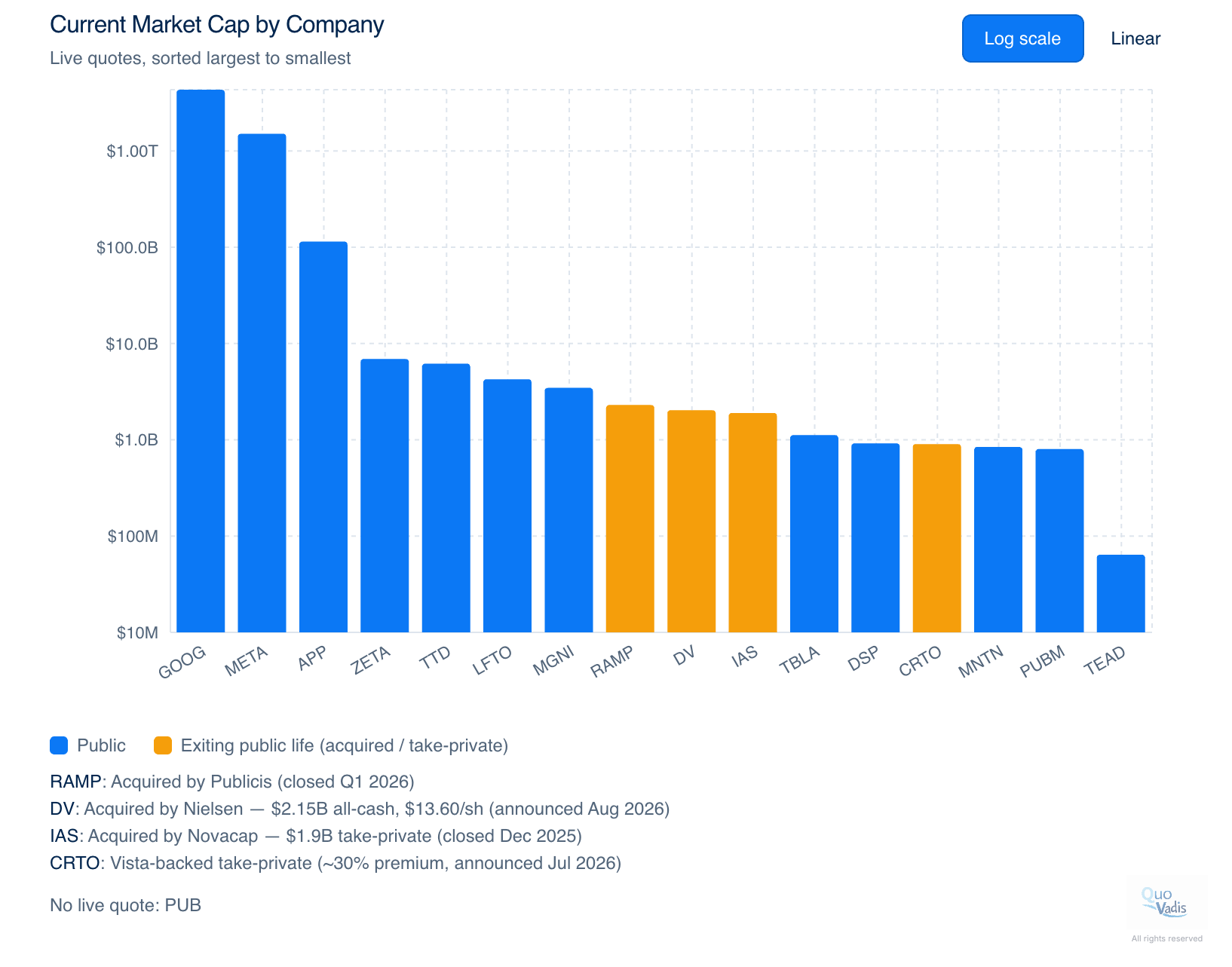
#1. PubMatic (PUBM), ~$800 million market cap, 60% probability
We think PubMatic might be the next domino to fall. From what we can tell, PUBM is an undifferentiated SSP trading at a fraction of revenue, but with a strong balance sheet, and the same profile PE just paid for at Criteo and IAS. Strategically, the SSP layer is consolidating around scale, and PUBM as a standalone has no path back to a public-market premium. Willing management is the only open question.
#2. Teads (TEAD), ~$70 million market cap, 55% probability
At a ~$70M market cap (↓95%), the most likely outcomes are a take-under, a sponsor-led recap, or a strategic scooping up of its demand-side relationships for a song and dance. We’d give Teads a high probability of an exit and a low probability that shareholders love the price.
#3. Viant (DSP), ~$900 million market cap, 45% probability
Profitable, founder-run, and one of the few remaining independent mid-market DSPs… exactly what a PE firm or a legacy media/retail-media buyer would want. The Vanderhook brothers’ dual-class control is the swing factor making a hostile approach likely impossible and a friendly one binary. If they decide to sell, we’d imagine it would likely happen fast.
#4 Taboola (TBLA), ~$1.1 billion market cap, 35% probability
Taboola generates real free cash flow and trades cheaply, which also fits the PE playbook. But Adam Singolda’s control position and the company’s self-image as a consolidator (not a target) argue against it. A sponsor could still make a founder-friendly offer that management can’t refuse. For example, a Taboola tie-up with Yahoo could become more permanent, with Apollo leading the way.
#5. Magnite (MGNI), ~$3.6 billion market cap, 25% probability
Magnite is a highly scaled independent SSP, and unlike everyone else in the space, it has proven its CTV positioning with a nice Q2 beat (+18% upside reaction). We think Magnite is more likely a buyer/consolidator of assets than a seller, but it’s also the single most strategic independent asset across CTV ad infrastructure. If Netflix, Amazon-adjacent players, or a large sponsor wants that layer, MGNI looks to be perhaps the most obvious scaled way to get there faster.
#6. MNTN (MNTN)~$800 million market cap, 20% probability
Sub-$1B in market cap, but it IPO’d barely a year ago, so management and crossover holders probably didn’t go public to sell the company twelve months later at a discount to the IPO narrative. However, as Mike Tyson wisely said, “Everyone has a plan until they get punched in the face.” We think MNTN becomes a better candidate for a take-private in 2027 if performance TV growth stalls.
#7. Zeta (ZETA), $6.6 billion market cap, 15% probability
Within our AdTech11 portfolio, Zeta is up ↑208% with a premium multiple to match, so we don’t see acquirers paying a 30% premium on top of momentum pricing. The identity/data-platform theme (see: LiveRamp) is strategically interesting to a holding company or enterprise-software buyer, but its size and price make it a stretch within 12 months. Similar to Magnite, we see Zeta as more of a buyer/aggregator than a seller.
#8 The Trade Desk (TTD), ~$6.5 billion market cap, 10% probability
The bitter irony. TTD is down ↓85% from our January 2022 anchor point and is now cheap enough to be discussed as a target for the first time ever. But Jeff Green’s voting control likely makes any unsolicited path a dead end, and at a $ 6.5B+ premium, the buyer universe is thin. From what we can tell, any big move, like going private, happens only if Green decides to make it so. For what it’s worth, we think The Trade Desk can make a big M&A play to reinvent and reinvigorate itself into the dominant strategy player.
Disclaimer: This post, and any other post from Quo Vadis, should not be considered investment advice. This content is for informational purposes only. You should not construe this information, or any other material from Quo Vadis, as investment, financial, or any other form of advice.